
7 Best Indoor Golf Simulators for 2026, Compared
We compared 7 indoor golf simulators for 2026, from budget swing trainers to launch monitors, enclosures and screens, to help you build the right home setup.

An indoor golf simulator can be a $280 swing stick or a $4,000 studio, and the right choice depends entirely on your room, your budget and whether you want to practice or just play. This guide compares seven real, widely owned options for 2026, spanning the two halves of any home setup: the tracking device that reads your shots and the enclosure and screen you hit into. We weighed each on the technology it uses, how much space it needs, how hard it is to set up, software and subscription costs, and value for the money. Whether you want a cheap way to play virtual rounds on a rainy day, an accurate launch monitor for real practice, or a complete room built around a screen, one of these picks fits. Below you will find the best overall choice plus category winners for budget, premium, shot data, enclosures, garages and screens, followed by a plain buying guide.
Table of contents
- Quick picks
- Price compared
- Comparison table
- Best Overall: Garmin Approach R10
- Best for Shot Data: Rapsodo MLM2PRO
- Best Budget: PHIGOLF Home Golf Simulator
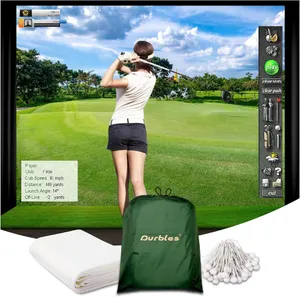
- Best Impact Screen: Durbles Golf Simulator Impact Screen
- Best for Garage Setups: Complete 4K Golf Simulator Enclosure Package
- Best Enclosure: GoSports Simulator Enclosure Kit
- Best Premium: SkyTrak ST MAX Studio Package
- How we researched these picks
- How to choose an indoor golf simulator (buying guide)
- FAQ
Quick picks
Every pick wins a specific use case. Jump to the full review before you buy.
-
Best Overall
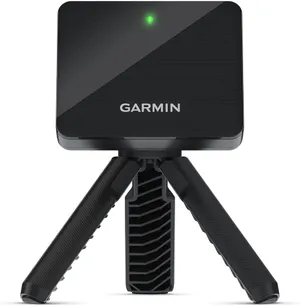
Garmin Approach R10
The Garmin Approach R10 is the most flexible way into indoor golf: an affordable radar launch monitor that drives real simulator software indoors and doubles as a range trainer outside.
-
Best for Shot Data
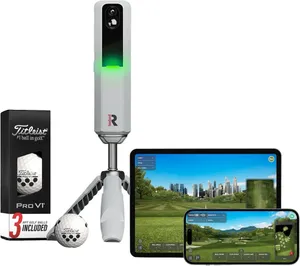
Rapsodo MLM2PRO
The Rapsodo MLM2PRO pairs dual cameras with radar and bundles its own course-play software, making it the strongest sub-$600 pick for golfers who want rich shot data and simulator play in one box.
-
Best Budget
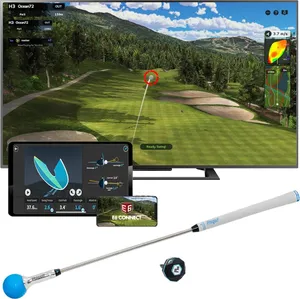
PHIGOLF Home Golf Simulator
The PHIGOLF swing-stick simulator is the cheapest realistic way to play virtual golf at home, trading measurement accuracy for a tiny footprint and thousands of playable courses.
-
Best Impact Screen
Durbles Golf Simulator Impact Screen
The Durbles triple-layer impact screen is the cheapest way to add a proper projection surface to a net or DIY frame, with the highest owner rating of any pick here.
-
Best for Garage Setups
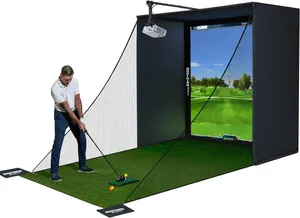
Complete 4K Golf Simulator Enclosure Package
This 4K-ready enclosure package delivers a blackout cage, impact screen, projector mount and side nets at a mid-range price, making it the value choice for turning a garage into a sim bay.
-
Best Enclosure
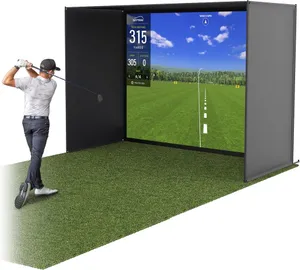
GoSports Simulator Enclosure Kit
The GoSports enclosure kit is the strongest way to build a simulator around a launch monitor you already own, pairing a heavy steel frame with an HD impact screen in one well-reviewed package.
-
Best Premium
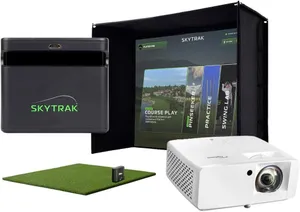
SkyTrak ST MAX Studio Package
The SkyTrak ST MAX Studio Package is a complete, room-ready simulator with launch monitor, enclosure, screen, mat and projector included, for buyers who want to hit balls on day one without assembling parts.
Compare every pick
| Product | Award | Type | Space needed | Setup | Price | Best for | Where to buy |
|---|---|---|---|---|---|---|---|
| Garmin Approach R10 | Best Overall | Doppler radar launch monitor | 8 ft ball flight or a net | Plug-and-play, portable | $499 | Most golfers wanting one device for home sim play and range work | Check price on Amazon for Garmin Approach R10 at Amazon (affiliate link) |
| Rapsodo MLM2PRO | Best for Shot Data | Dual-camera and radar launch monitor | 8 ft ball flight or a net | Plug-and-play, portable | $600 | Data-driven golfers who want detailed numbers plus sim play under $600 | Check price on Amazon for Rapsodo MLM2PRO at Amazon (affiliate link) |
| PHIGOLF Home Golf Simulator | Best Budget | Swing-stick motion simulator | Small room, swing clearance only | Plug-and-play, portable | $280 | Beginners and casual players who want cheap indoor course play in a small space | Check price on Amazon for PHIGOLF Home Golf Simulator at Amazon (affiliate link) |
| Durbles Golf Simulator Impact Screen | Best Impact Screen | Impact and projection screen | Sized to your enclosure frame | Hang with included cords | $160 | DIY builders adding a projection surface to a net or homemade frame | Check price on Amazon for Durbles Golf Simulator Impact Screen at Amazon (affiliate link) |
| Complete 4K Golf Simulator Enclosure Package | Best for Garage Setups | Enclosure and impact screen | Garage-friendly cage footprint | Full assembly required | $700 | Value seekers converting a garage or basement into a simulator bay | Check price on Amazon for Complete 4K Golf Simulator Enclosure Package at Amazon (affiliate link) |
| GoSports Simulator Enclosure Kit | Best Enclosure | Enclosure and impact screen | 10 x 8 ft up to 14 x 8 ft footprint | Full assembly required | $1,000 | Golfers who own a launch monitor and want a durable screen and frame to hit into | Check price on Amazon for GoSports Simulator Enclosure Kit at Amazon (affiliate link) |
| SkyTrak ST MAX Studio Package | Best Premium | All-in-one studio package | Dedicated room, about 10 x 10 ft | Full assembly required | $3,995 | Buyers building a permanent, high-accuracy sim room who want it all in one box | Check price on Amazon for SkyTrak ST MAX Studio Package at Amazon (affiliate link) |
Swipe sideways to compare every column.
Best Overall
Garmin Approach R10
by Garmin
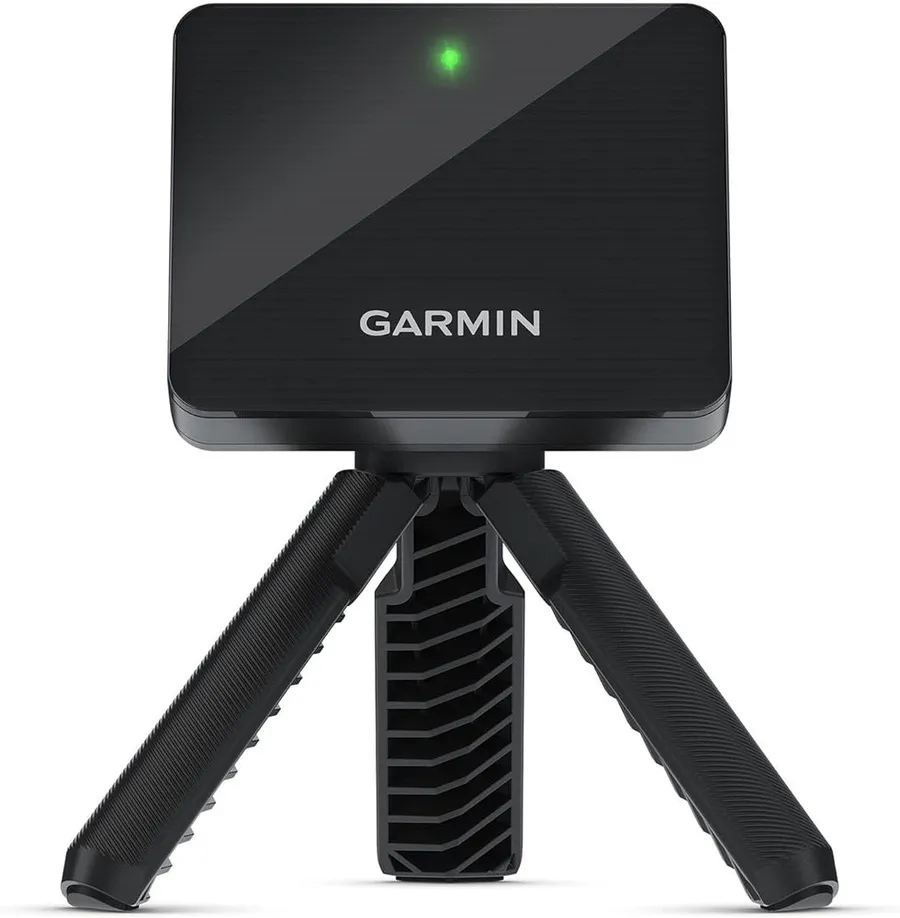
The Garmin Approach R10 is the most flexible way into indoor golf: an affordable radar launch monitor that drives real simulator software indoors and doubles as a range trainer outside.
What we like
- Reads a full set of ball and club metrics for the price
- Runs virtual courses through the Garmin Golf app on a phone, tablet or TV
- Portable, battery powered and works indoors into a net or outdoors on the range
What we don't
- As a radar unit it wants roughly 8 feet of ball flight, so a shallow room can dent its accuracy
| Type | Doppler radar launch monitor |
|---|---|
| Best for | All-round home simulator use |
| Space needed | 8 ft ball flight or a net |
| Setup | Plug-and-play, portable |
| Price | $499 |
| Install difficulty | Easy |
| Price bracket | $$ |
The Approach R10 wins on versatility and value, which is exactly what most people want from their first indoor golf simulator. It is a Doppler radar unit that pairs with the free Garmin Golf app, so the same small box that shows you ball speed and carry on the range also runs virtual rounds on your phone or a TV at home. Few devices near this price do both jobs credibly.
Day to day it is genuinely easy to live with. It sets up on the included tripod in seconds, charges over USB and runs for around ten hours, and the app readout is clear enough to use without a coach. Hit into a net indoors and you get instant feedback and simulated course play without building a permanent studio.
The honest limitation is space. Because radar tracks the ball in flight, the R10 likes about eight feet of travel to be at its most accurate. In a deep garage or basement that is fine, but in a shallow spare room a camera-based unit will read impact more reliably. It is also a tracking device, not a full setup, so you still add a mat and a net or screen.
Buy the R10 if you want one affordable, portable brain for both indoor sim play and outdoor practice. If you only ever hit indoors in a tight bay and demand tour-level precision, look at a camera unit or the SkyTrak package instead.
Research-based pick: this recommendation is based on product data, owner feedback and comparison with products we have tested, not on direct hands-on testing.
Buy it if: Most golfers wanting one device for home sim play and range work
Skip it if: You have a very shallow room and want lab-grade indoor numbers
Best for Shot Data
Rapsodo MLM2PRO
by Rapsodo
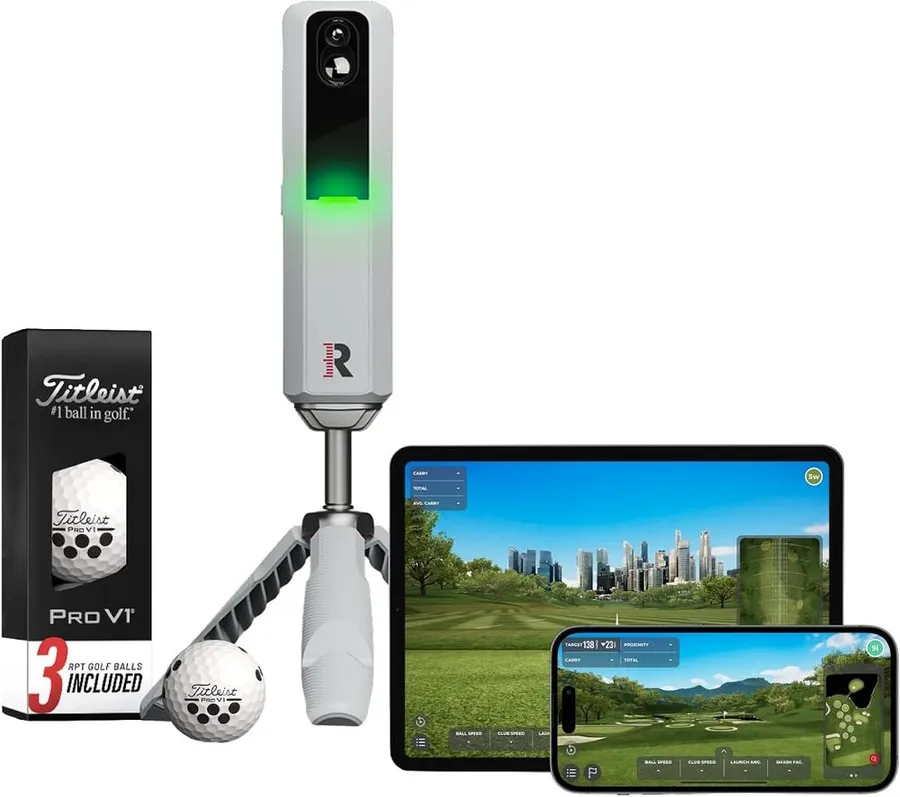
The Rapsodo MLM2PRO pairs dual cameras with radar and bundles its own course-play software, making it the strongest sub-$600 pick for golfers who want rich shot data and simulator play in one box.
What we like
- Dual-camera plus radar system reports a deep 15-metric shot set
- Includes impact vision video and its own simulator course play
- Portable and works indoors into a net or outdoors on the range
What we don't
- The best data and full course library sit behind a paid annual membership
| Type | Dual-camera and radar launch monitor |
|---|---|
| Best for | Detailed shot data and sim play |
| Space needed | 8 ft ball flight or a net |
| Setup | Plug-and-play, portable |
| Price | $600 |
| Install difficulty | Easy |
| Price bracket | $$ |
The MLM2PRO is the pick for anyone who cares about the numbers. Where a plain radar trainer estimates from flight, the Rapsodo combines two cameras with radar to read a fuller, more trustworthy 15-metric set, then adds slow-motion impact video so you can actually see what your club did. For practice you can measure and improve, that combination is hard to beat at the price.
It is also a complete simulator on a budget. The unit ships ready to run Rapsodo’s own course-play software, so you can hit into a net at home and play virtual holes rather than just staring at data. It is portable, battery friendly and just as happy on the driving range, which makes it an easy one-device answer for mixed indoor and outdoor use.
The catch to weigh is the subscription. Out of the box you get core function, but the richest metrics and the full course library are unlocked by a paid annual membership. That recurring cost changes the value math, so factor it in before comparing the sticker price with the Garmin R10.
Choose the MLM2PRO if detailed shot data and built-in sim play matter more than avoiding a subscription. If you want the simplest possible all-rounder, the R10 is friendlier, and if you want a turnkey room with a screen included, step up to the SkyTrak package.
Research-based pick: this recommendation is based on product data, owner feedback and comparison with products we have tested, not on direct hands-on testing.
Buy it if: Data-driven golfers who want detailed numbers plus sim play under $600
Skip it if: You want a no-subscription device or a fully built studio out of the box
Best Budget
PHIGOLF Home Golf Simulator
by PHIGOLF
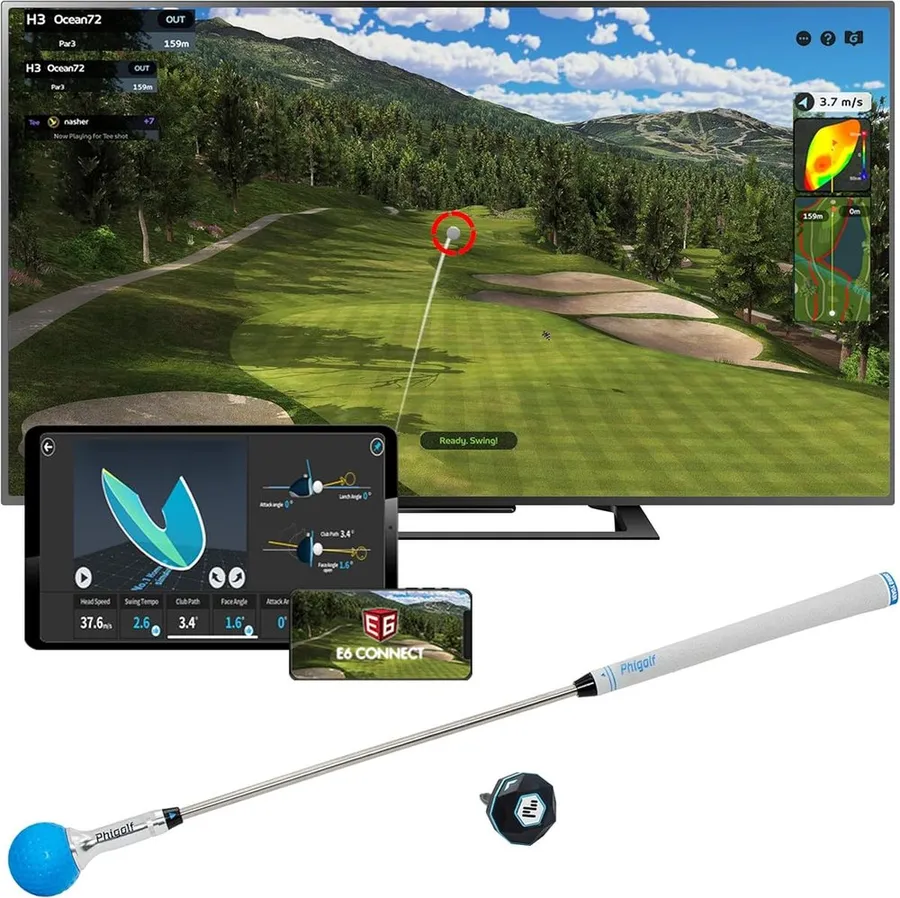
The PHIGOLF swing-stick simulator is the cheapest realistic way to play virtual golf at home, trading measurement accuracy for a tiny footprint and thousands of playable courses.
What we like
- By far the lowest price of any pick here
- Motion-sensor swing stick needs only a small room and no ball, net or screen
- Access to a large library of virtual courses and E6 Connect compatibility
What we don't
- A motion-sensor stick estimates your swing rather than measuring a real struck ball, so data is approximate
| Type | Swing-stick motion simulator |
|---|---|
| Best for | Budget indoor course play |
| Space needed | Small room, swing clearance only |
| Setup | Plug-and-play, portable |
| Price | $280 |
| Install difficulty | Easy |
| Price bracket | $ |
PHIGOLF earns the budget pick by solving the indoor problem in the simplest way possible. Instead of a launch monitor, mat and net, you swing a sensor-equipped stick, and the app turns that motion into a shot on screen. That means you can play a virtual round in a small room with almost no setup and none of the cost of a real hitting bay.
What you get for the money is genuinely fun. The app connects to a large library of courses worldwide and works with popular simulator platforms including E6 Connect, so casual players and beginners get the feel of playing somewhere new on a rainy evening without spending four figures.
The trade-off is accuracy, and it is a real one. A motion sensor infers your swing rather than measuring a real ball leaving a real clubface, so the numbers are approximate and it will not help you fine-tune spin or true carry. Owner ratings reflect that it is treated as a fun toy more than a training tool.
Buy PHIGOLF if your goal is low-cost indoor entertainment and easy course play in a tight space. If you want to actually improve with reliable data, put the money toward a Garmin R10 or Rapsodo MLM2PRO instead.
Research-based pick: this recommendation is based on product data, owner feedback and comparison with products we have tested, not on direct hands-on testing.
Buy it if: Beginners and casual players who want cheap indoor course play in a small space
Skip it if: You want accurate launch data or to practice with your own clubs and real balls
Best Impact Screen
Durbles Golf Simulator Impact Screen
by Durbles
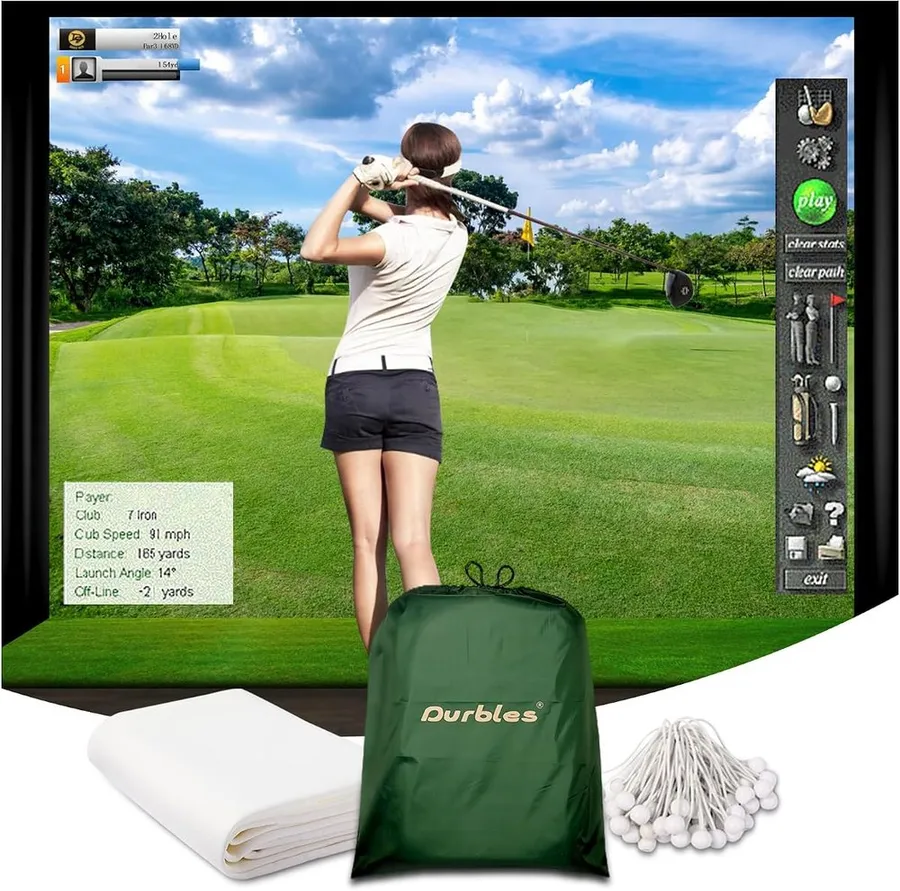
The Durbles triple-layer impact screen is the cheapest way to add a proper projection surface to a net or DIY frame, with the highest owner rating of any pick here.
What we like
- Triple-layer build absorbs real-ball impact while showing a bright projected image
- Ships with grommets and bungee cords for a quick hang on most frames
- Lowest-cost route to a real simulator screen, with a strong owner rating
What we don't
- It is a screen only, so you need an existing frame or net and a projector to use it
| Type | Impact and projection screen |
|---|---|
| Best for | Adding a screen to an existing net |
| Space needed | Sized to your enclosure frame |
| Setup | Hang with included cords |
| Price | $160 |
| Install difficulty | Easy |
| Price bracket | $ |
The Durbles screen is the pick for anyone building a simulator on a budget or piecing one together from parts they already have. It is a triple-layer impact screen that takes real-ball strikes while giving a projector a bright, even surface to display on, and at this price it is the least expensive way to add a true sim screen to a setup.
It is also refreshingly simple to fit. The screen comes with grommets and bungee cords, so you can stretch it across an existing hitting net, a doorway frame or a homemade PVC structure in minutes rather than committing to a full enclosure. That flexibility, plus the highest verified owner rating in this guide, is why it stands out among screen-only options.
The limitation is right there in the category: it is only the screen. You still need something to hang it on and a projector to light it up, so it is a component rather than a finished product. Hang it too loosely or without side protection and stray shots can miss the surface.
Choose the Durbles screen if you are a DIY builder who wants a quality projection surface for the least money. If you would rather buy a matched frame and screen together, the GoSports or 4K enclosure kits include both, and the SkyTrak package includes the screen and the tracking hardware in one go.
Research-based pick: this recommendation is based on product data, owner feedback and comparison with products we have tested, not on direct hands-on testing.
Buy it if: DIY builders adding a projection surface to a net or homemade frame
Skip it if: You want a complete enclosure or an all-in-one simulator package
Best for Garage Setups
Complete 4K Golf Simulator Enclosure Package
by Golf Sim
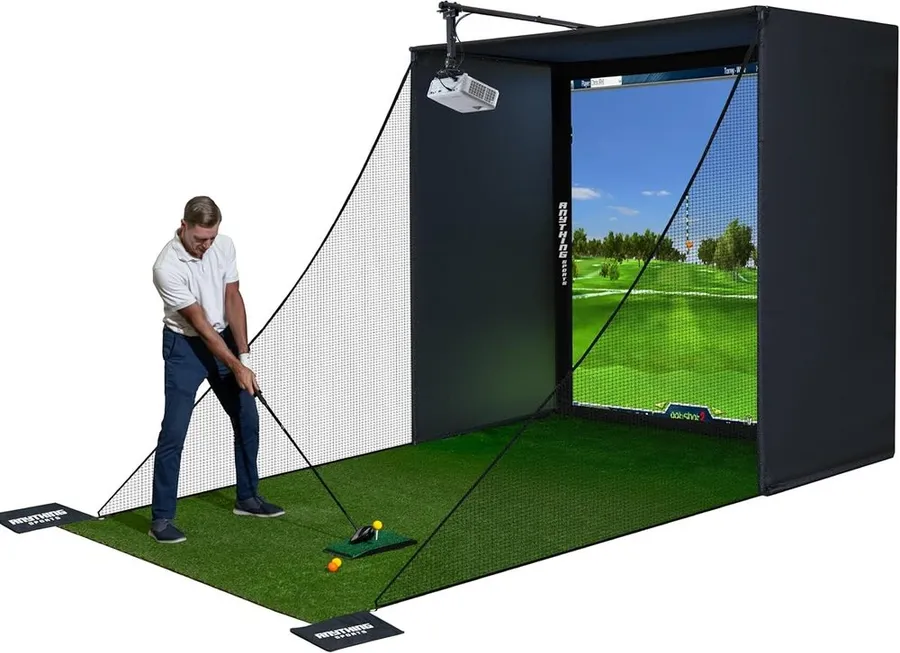
This 4K-ready enclosure package delivers a blackout cage, impact screen, projector mount and side nets at a mid-range price, making it the value choice for turning a garage into a sim bay.
What we like
- Bundles a 4K-ready impact screen, blackout cage, projector mount and side shank nets
- Blackout cage improves projected image contrast in a bright garage
- Cheaper than premium enclosures while still including a projector mount
What we don't
- Frame and materials are less heavy-duty than pricier steel-framed kits
| Type | Enclosure and impact screen |
|---|---|
| Best for | A value garage sim bay |
| Space needed | Garage-friendly cage footprint |
| Setup | Full assembly required |
| Price | $700 |
| Install difficulty | Moderate |
| Price bracket | $$ |
This package is the value way to enclose a simulator, and it is built with the garage in mind. Alongside the 4K-ready impact screen you get a blackout cage, a projector mount and side shank nets in one box, which covers most of what a garage bay needs to protect the walls and throw a clean image, all for a mid-range price.
The blackout cage is the detail that matters day to day. Garages are rarely dark, and a shrouded enclosure keeps stray light off the screen so the projected course looks sharper. Having the projector mount included also saves the fiddly job of rigging a separate ceiling bracket, which speeds up a first-time setup.
Where it gives ground is toughness. The frame and fabrics are lighter than the steel-framed premium kits, so it should hold up to normal home use but is not the choice if you plan to hammer it daily for years. As with any enclosure, it also does not include a launch monitor, projector or mat.
Pick this kit if you want the most simulator shell for the money and a garage-friendly blackout design. If you want maximum durability, the GoSports steel-framed enclosure is the sturdier buy, and if you want the tracking hardware included, the SkyTrak package is the turnkey route.
Research-based pick: this recommendation is based on product data, owner feedback and comparison with products we have tested, not on direct hands-on testing.
Buy it if: Value seekers converting a garage or basement into a simulator bay
Skip it if: You want the sturdiest possible frame or an all-in-one kit with a launch monitor
Best Enclosure
GoSports Simulator Enclosure Kit
by GoSports
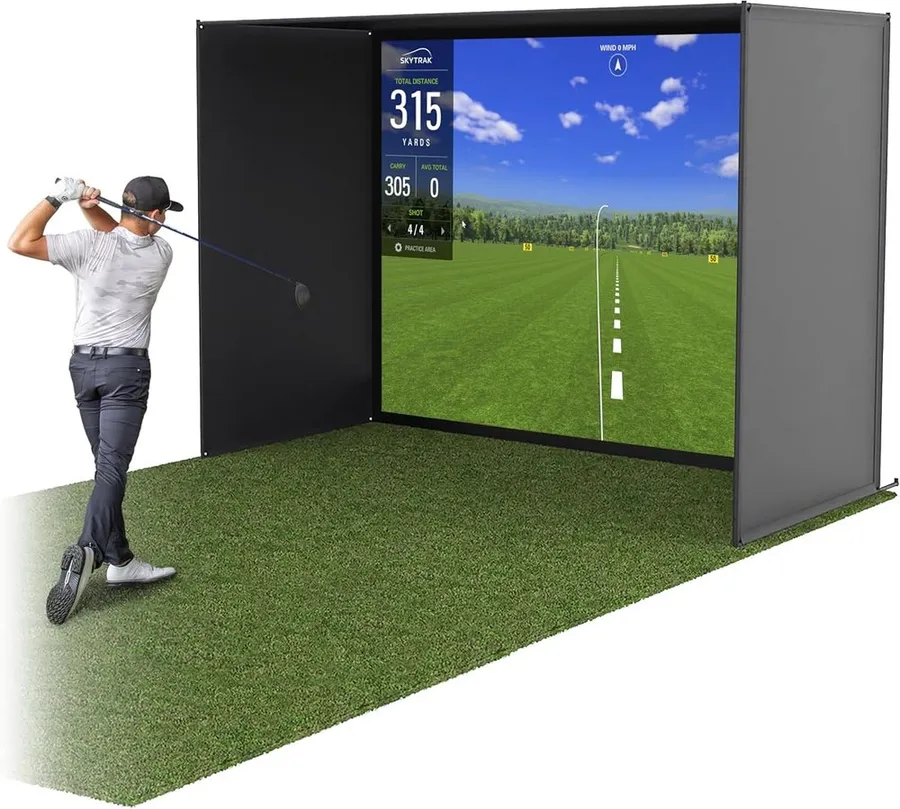
The GoSports enclosure kit is the strongest way to build a simulator around a launch monitor you already own, pairing a heavy steel frame with an HD impact screen in one well-reviewed package.
What we like
- Combines a sturdy steel frame with an HD impact and projection screen
- Offered in 10x8, 12x9 and 14x8 ft sizes to fit different rooms
- Strong verified owner rating from a recognized golf brand
What we don't
- It is only the enclosure, so you still supply the launch monitor, projector and mat
| Type | Enclosure and impact screen |
|---|---|
| Best for | Building a sim around your own monitor |
| Space needed | 10 x 8 ft up to 14 x 8 ft footprint |
| Setup | Full assembly required |
| Price | $1,000 |
| Install difficulty | Moderate |
| Price bracket | $$$ |
If you already have a launch monitor like a Garmin R10 or Rapsodo, the enclosure is the piece that turns it into a real simulator, and the GoSports kit is the pick that gets it right. It bundles a heavy-duty steel frame with an HD impact screen that doubles as your projection surface, so you get both the structure and the display in one order rather than sourcing them separately.
In use it is the difference between staring at a phone and playing golf on a wall-sized image. The frame is built to take repeated real-ball strikes, and the multiple size options mean you can match it to a 10-foot spare room or a wider garage bay. The strong owner rating from an established brand is reassuring for a product that has to survive being hit thousands of times.
The thing to be clear about is scope. This is the enclosure and screen only. You still bring the launch monitor, a projector and a hitting mat, so the price on the box is not the price of a finished simulator. Budget for those extras before you compare it with an all-in-one package.
Choose the GoSports kit if you have a tracking device and want a durable, properly sized screen and frame to complete the room. If you would rather buy everything at once, the SkyTrak package includes the hardware, and if you want to spend less on the shell, the value 4K enclosure is worth a look.
Research-based pick: this recommendation is based on product data, owner feedback and comparison with products we have tested, not on direct hands-on testing.
Buy it if: Golfers who own a launch monitor and want a durable screen and frame to hit into
Skip it if: You want a complete simulator that includes the tracking hardware
Best Premium
SkyTrak ST MAX Studio Package
by SkyTrak
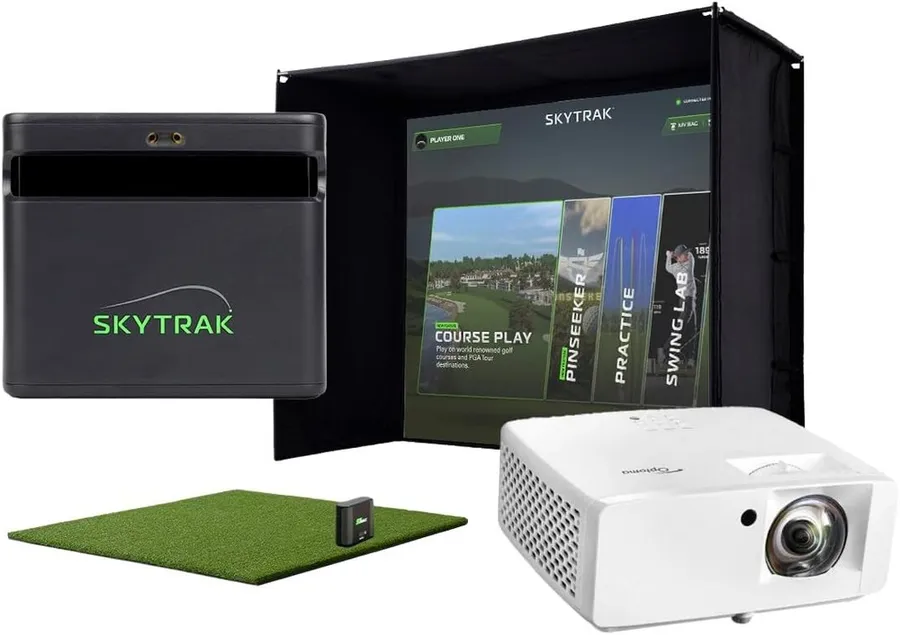
The SkyTrak ST MAX Studio Package is a complete, room-ready simulator with launch monitor, enclosure, screen, mat and projector included, for buyers who want to hit balls on day one without assembling parts.
What we like
- Everything in one package: launch monitor, enclosure, impact screen, 5x5 mat and projector
- ST MAX unit uses both radar and cameras to stay accurate in a small indoor room
- Turnkey studio removes the guesswork of matching separate components
What we don't
- By far the most expensive option, and full software and course play add ongoing cost
| Type | All-in-one studio package |
|---|---|
| Best for | A permanent premium sim room |
| Space needed | Dedicated room, about 10 x 10 ft |
| Setup | Full assembly required |
| Price | $3,995 |
| Install difficulty | Hard |
| Price bracket | $$$ |
The ST MAX package is the premium pick because it removes every decision after checkout. Rather than buying a launch monitor, then a screen, then a mat, then a projector and hoping they fit together, you get a matched studio in one order: the ST MAX unit, an enclosure and impact screen, a 5x5 hitting mat and a projector with trial software. For a permanent room, that convenience is worth a lot.
The hardware underneath is the serious part. The ST MAX blends radar with camera tracking, so unlike a radar-only trainer it stays accurate in a shallow indoor bay where ball flight is short. That makes it a true indoor performer, not a range unit pressed into home duty, and the bundled screen and projector turn your shots into full simulated courses.
The obvious limitation is cost and commitment. This is a four-figure purchase that expects a dedicated space you can leave assembled, and the richest software and course play carry ongoing fees on top. It is overkill for anyone who just wants occasional rainy-day practice.
Choose the ST MAX package if you are building a lasting, high-accuracy simulator room and want a single, coordinated setup. If you want flexibility or a lower price, a Garmin R10 or Rapsodo MLM2PRO paired with a separate enclosure gets you playing for far less.
Research-based pick: this recommendation is based on product data, owner feedback and comparison with products we have tested, not on direct hands-on testing.
Buy it if: Buyers building a permanent, high-accuracy sim room who want it all in one box
Skip it if: You are on a budget or lack a dedicated room to leave it set up
How we researched these picks#
We built this list by starting from the indoor golf products people actually buy, then filtering hard on evidence and relevance. Every pick here is a real, currently sold product with verified owner reviews, and together they cover both halves of a home setup: the device that tracks your shots and the enclosure or screen you hit into.
For each candidate we pulled the manufacturer or listing specifications, read across aggregated verified owner feedback, and compared products head to head on the factors that change a buying decision: the technology and how accurate it is indoors, how much room it needs, how much setup and assembly it demands, software and subscription costs, and overall value at the price. We deliberately spread the final seven across price brackets and roles, from a $160 screen and a $280 swing stick up to a near-$4,000 complete studio, so there is a sensible pick for different budgets, rooms and goals.
These recommendations are research-based, not hands-on tested. We have not built each setup ourselves, so we lean on published specs and the consistent themes in owner feedback rather than our own bay data. Where a product has a real weakness, such as a subscription requirement, a space constraint or a lighter frame, we call it out plainly.
How to choose an indoor golf simulator (buying guide)#
Decide whether you want to practice or play. If your goal is reliable data to improve, you need a launch monitor that measures a real ball, such as the Garmin R10 or Rapsodo MLM2PRO. If you mostly want to play virtual courses for fun in a small space, a swing-stick sim like PHIGOLF does that for far less, at the cost of accuracy.
Match the tracking technology to your room. Doppler radar reads the ball in flight and wants about 8 feet of travel, so it suits a deep garage or basement. Camera and hybrid units measure at or near impact and stay accurate close to a screen, which makes them the better fit for a shallow spare room. A hybrid system like the SkyTrak ST MAX is the most forgiving indoors.
Measure your space before anything else. A full bay typically needs a footprint around 10 by 8 feet and enough ceiling height to swing your driver, often 9 to 10 feet. Check width, depth and height in the actual room, because a great launch monitor is wasted if you cannot make a full swing or give a radar unit the flight it needs.
Buy the pieces separately or as one package. Pairing a launch monitor with a separate enclosure and screen, like the GoSports or 4K kits, is cheaper and more flexible but means matching parts and sizes. An all-in-one studio such as the SkyTrak package costs more but includes the monitor, screen, mat and projector already matched, which is the simplest path to a finished room.
Budget for software and subscriptions. Sticker price is not always the full cost. Basic radar and swing-stick units work out of the box, but several simulator-capable devices gate their richest metrics and course play behind a paid annual plan. Add that recurring fee so two products at the same price are judged fairly.
Do not forget the screen, mat and projector. If you choose a tracking device or a bare enclosure, remember the extras that complete a bay: an impact screen like the Durbles for the image, a quality hitting mat to protect your joints and clubs, and a projector to throw the course. Factor these into the total before you compare a component with a complete package.
Frequently asked questions
How much space do I need for an indoor golf simulator?
It depends on the tracking technology and the enclosure. Radar launch monitors like the Garmin R10 want roughly 8 feet of ball flight to read shots accurately, so a shallow room hurts them, while camera and hybrid units such as the SkyTrak ST MAX stay accurate a few feet from a screen. For a full bay, plan on a footprint around 10 by 8 feet and a ceiling high enough for your driver, often about 9 to 10 feet. A swing-stick sim like PHIGOLF needs only room to swing.
Do I need a launch monitor and an enclosure, or an all-in-one?
Both approaches work. Buying a launch monitor such as the Garmin R10 or Rapsodo MLM2PRO and adding an enclosure and screen separately is more flexible and usually cheaper, but you have to match the parts. An all-in-one package like the SkyTrak ST MAX includes the monitor, screen, mat and projector together, which costs more but removes the guesswork and gets you playing on day one.
Do indoor golf simulators need a subscription?
Some do for their best features. A basic swing-stick sim and radar trainers show core function without fees, but simulator-focused launch monitors like the Rapsodo MLM2PRO and premium systems put their full metrics and course libraries behind a paid annual plan. Add that recurring cost to your budget before comparing sticker prices.
Are cheap indoor golf simulators accurate?
It depends what they measure. A budget swing-stick unit like PHIGOLF estimates your swing from a motion sensor rather than reading a real struck ball, so it is fun but approximate. If you want reliable data to improve your game, a radar or camera launch monitor that measures an actual golf ball is worth the step up in price.
About the author

Jim Bennett Founder & lead reviewer
Jim is the guy behind Golf Sim Jim. He builds home golf simulators and compares launch monitors by the numbers that actually decide a setup, room fit, accuracy and software.
Home setup: Garage bay: SkyTrak+, 10 ft ceiling, BenQ LK936ST short-throw
- Launch monitor accuracy
- Home simulator builds
- Impact screens & enclosures
- Sim software (GSPro, E6, TGC)