
7 Cheapest Indoor Golf Simulators Compared for 2026
We compared 7 real ways to build the cheapest indoor golf simulator, from a $160 screen to a full studio, on price, space, accuracy and value.

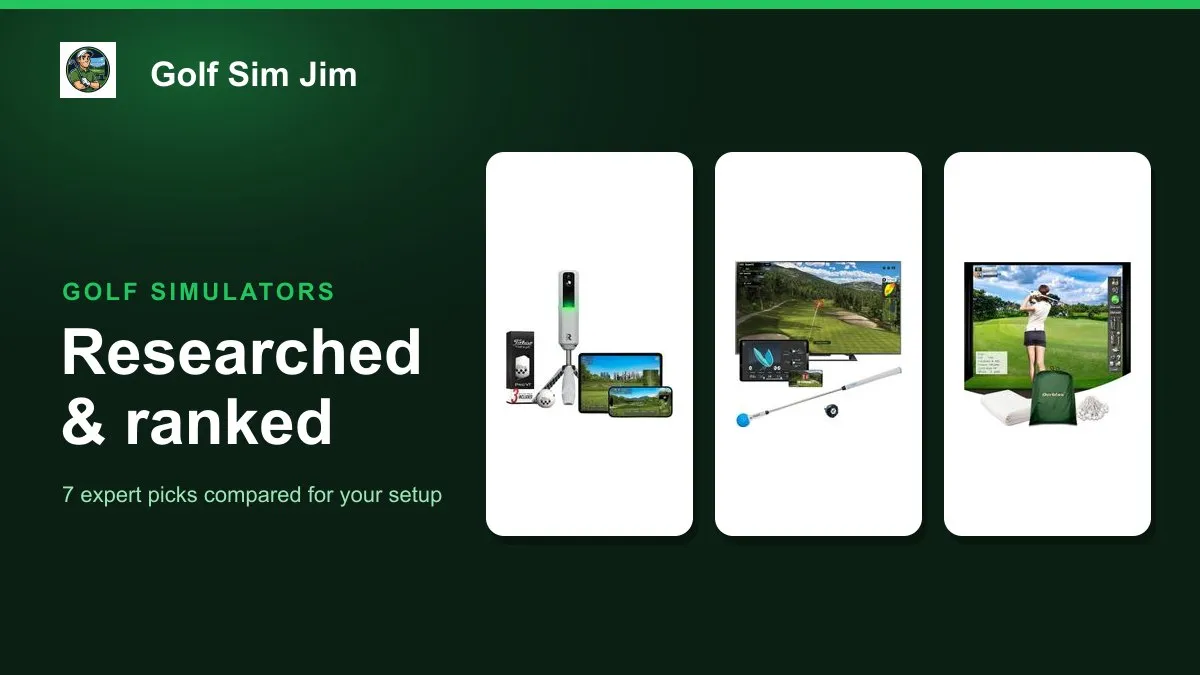
There is no single cheapest indoor golf simulator, because the price depends on how you get there: a small launch monitor that plays courses on your phone, a swing-stick sensor that costs less than a driver, a bare impact screen you hang on your own frame, or a ready-made enclosure. This guide compares seven real, widely owned products from $160 to just under $5,000, covering every budget route into indoor golf. We weighed each on the total cost to get playing, the space it needs, how accurate its data is, how much of the build it does for you and overall value. Whether you want the least you can spend to play virtual rounds, a compact shell for a single-car garage or a complete studio in one box, one of these picks fits your room and your budget. Below is the best overall pick plus category winners for the tightest budget, DIY builds, small spaces, value kits, premium enclosures and one-box studios, followed by a plain buying guide.
Table of contents
- Quick picks
- Price compared
- Comparison table
- Best Overall: Rapsodo MLM2PRO
- Best Budget: PHIGOLF Home Golf Simulator
- Best for DIY Builds: Triple Layer Golf Simulator Impact Screen
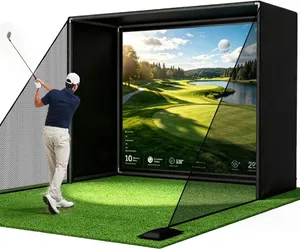
- Best for Small Spaces: 10x8 Golf Simulator Enclosure
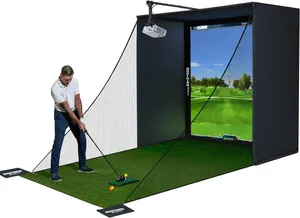
- Best Value Kit: Complete Golf Simulator Enclosure Package
- Best Premium Enclosure: GoSports Golf Simulator Enclosure
- Best All-in-One: SkyTrak ST MAX Ultimate Studio Package
- How we researched these picks
- How to choose a cheap indoor golf simulator (buying guide)
- FAQ
Quick picks
Every pick wins a specific use case. Jump to the full review before you buy.
-
Best Overall
Rapsodo MLM2PRO
For the money, nothing else turns a bare room into a real indoor simulator as completely as the MLM2PRO, a dual-camera and radar unit that reads your shots and plays virtual courses through an app.
-
Best Budget
PHIGOLF Home Golf Simulator
If you want to play virtual golf indoors for under $300 and do not care about tour-level data, PHIGOLF is the cheapest genuine simulator here, using a clip-on sensor and a swing stick to put you on 38,000 courses.
-
Best for DIY Builds
Triple Layer Golf Simulator Impact Screen
The cheapest simulator is often one you assemble yourself, and this triple-layer impact screen is the low-cost surface that lets you project a course onto a frame you already have.
-
Best for Small Spaces
10x8 Golf Simulator Enclosure
At 10 by 8 feet with a screen and side nets already included, this budget enclosure is the cheapest ready-made shell that fits a single-car garage or spare room.
-
Best Value Kit
Complete Golf Simulator Enclosure Package
This package bundles a 4K-ready screen, a blackout cage and a projector mount into one box, doing most of the physical build for you at a price that still leaves room in the budget for a launch monitor.
-
Best Premium Enclosure
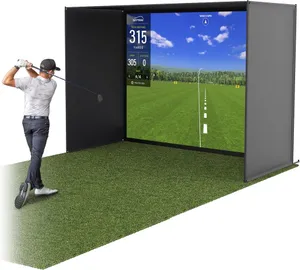
GoSports Golf Simulator Enclosure
GoSports builds the sturdiest shell in this budget-minded lineup, a heavier steel frame with an HD impact screen that stands up to hard, frequent driver sessions and comes in three sizes.
-
Best All-in-One
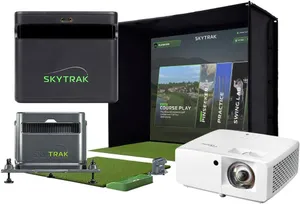
SkyTrak ST MAX Ultimate Studio Package
If your idea of cheap is the lowest total cost with zero sourcing headaches, the SkyTrak ST MAX studio arrives as one box with the monitor, screen, projector, mat and enclosure already matched.
Compare every pick
| Product | Award | Type | What you get | Price | Warranty | Best for | Where to buy |
|---|---|---|---|---|---|---|---|
| Rapsodo MLM2PRO | Best Overall | Launch monitor sim | Dual-camera monitor, app, 3 balls | $600 | 1 year | Anyone who wants the cheapest complete indoor simulator that plays real courses | Check price on Amazon for Rapsodo MLM2PRO at Amazon (affiliate link) |
| PHIGOLF Home Golf Simulator | Best Budget | Swing-stick sim | Motion sensor, swing stick, app | $280 | 1 year | Casual golfers who want cheap indoor course play with almost no space | Check price on Amazon for PHIGOLF Home Golf Simulator at Amazon (affiliate link) |
| Triple Layer Golf Simulator Impact Screen | Best for DIY Builds | Impact screen | Triple-layer HD screen, grommets, bungees | $160 | 1 year | DIY builders framing their own bay who just need a quality screen | Check price on Amazon for Triple Layer Golf Simulator Impact Screen at Amazon (affiliate link) |
| 10x8 Golf Simulator Enclosure | Best for Small Spaces | Enclosure + screen | 10x8 ft steel frame, impact screen, side nets | $400 | 1 year | Golfers with a small garage or room who want a cheap ready-made shell | Check price on Amazon for 10x8 Golf Simulator Enclosure at Amazon (affiliate link) |
| Complete Golf Simulator Enclosure Package | Best Value Kit | Enclosure + screen | 4K-ready screen, blackout cage, projector mount | $700 | 1 year | Buyers who want the enclosure decision made in one purchase | Check price on Amazon for Complete Golf Simulator Enclosure Package at Amazon (affiliate link) |
| GoSports Golf Simulator Enclosure | Best Premium Enclosure | Enclosure + screen | Steel frame, HD impact screen, net kit | $1,000 | 1 year | Regular players who want a durable enclosure that lasts for years | Check price on Amazon for GoSports Golf Simulator Enclosure at Amazon (affiliate link) |
| SkyTrak ST MAX Ultimate Studio Package | Best All-in-One | All-in-one studio | Launch monitor, screen, projector, mat, enclosure | $4,995 | 1 year | Buyers who want a complete studio in one box with no assembly guesswork | Check price on Amazon for SkyTrak ST MAX Ultimate Studio Package at Amazon (affiliate link) |
Swipe sideways to compare every column.
Best Overall
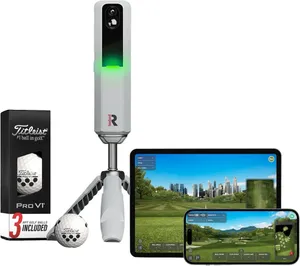
Rapsodo MLM2PRO
by Rapsodo
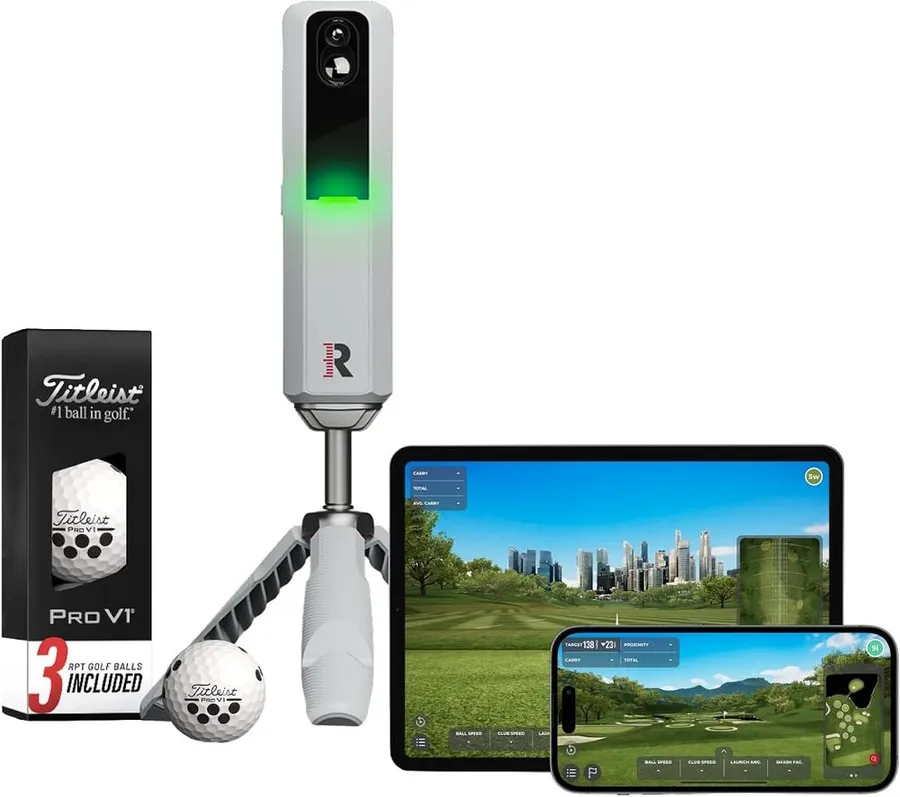
For the money, nothing else turns a bare room into a real indoor simulator as completely as the MLM2PRO, a dual-camera and radar unit that reads your shots and plays virtual courses through an app.
What we like
- Dual camera and radar reads 15 metrics including club and ball data
- Plays virtual courses and driving range sessions through the app
- Comes with three premium balls and works indoors or at the range
- Sets up in about five minutes with no wiring or mounting
What we don't
- Full metrics and course library sit behind a paid annual membership after the first year
| Type | Launch monitor sim |
|---|---|
| What you get | Dual-camera monitor, app, 3 balls |
| Best for | All-round home simulation |
| Price | $600 |
| Warranty | 1 year |
| Install difficulty | Easy |
| Price bracket | $$ |
The cheapest way to get a true indoor golf simulator, one that reads your swing and lets you play St Andrews from the garage, is not a giant box but a small launch monitor, and the MLM2PRO is the one that does it best for the price. It sits on the mat a set distance behind the ball, combines dual cameras with radar to read 15 metrics, and renders the result as course play or a practice range on your phone or tablet.
Day to day it is the easy part of any build. The unit pairs over the app in a few minutes and needs no permanent wiring, so you can carry it from the spare room to the range in a bag. It ships with three premium balls, and the camera side captures a video of every swing for review, which is more than most budget units offer.
The real catch is the subscription. The sticker gets you the hardware and a first year, but the richest metrics and the full course library move behind a paid annual membership after that, so budget for the recurring fee rather than treating the price as final.
Pair it with any net or an impact screen and you have a complete simulator that plays real courses for a fraction of a turnkey studio. If all you want is to groove a swing into a net without numbers, you do not need this, and a cheaper swing-stick sim or a bare cage will do.
Research-based pick: this recommendation is based on product data, owner feedback and comparison with products we have tested, not on direct hands-on testing.
Buy it if: Anyone who wants the cheapest complete indoor simulator that plays real courses
Skip it if: You only want to whack balls into a net and do not care about data
Best Budget
PHIGOLF Home Golf Simulator
by PHIGOLF
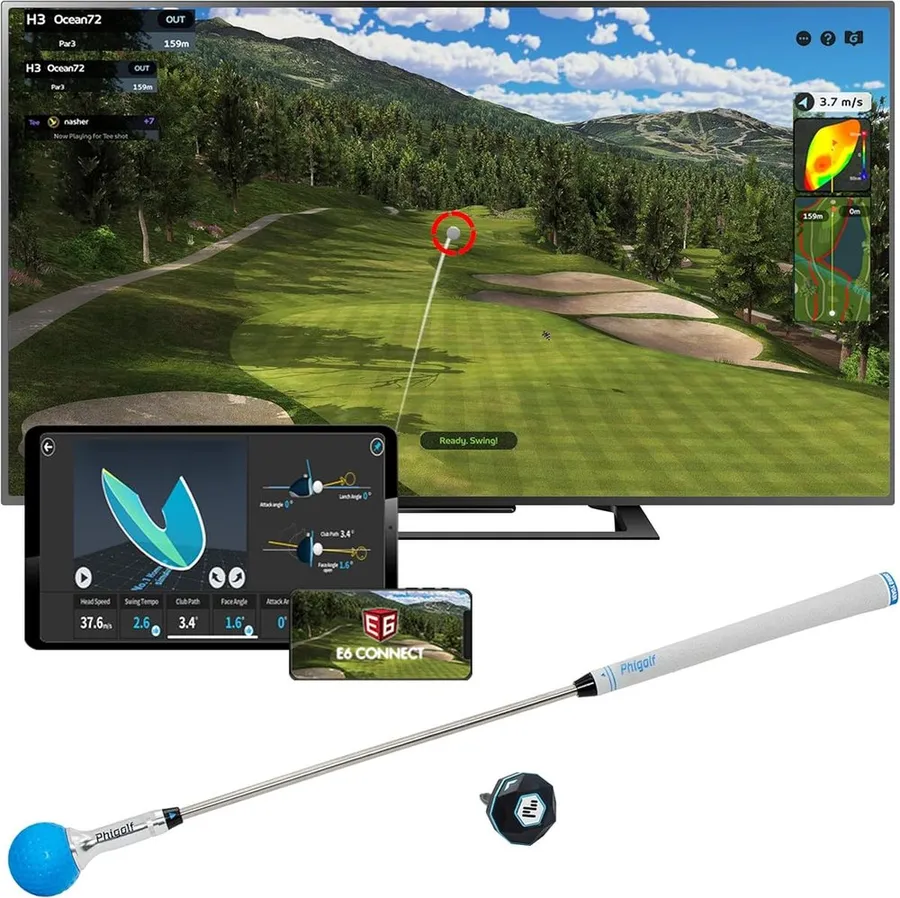
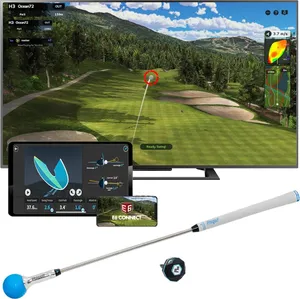
If you want to play virtual golf indoors for under $300 and do not care about tour-level data, PHIGOLF is the cheapest genuine simulator here, using a clip-on sensor and a swing stick to put you on 38,000 courses.
What we like
- Lowest-cost way to play full virtual courses indoors
- Motion sensor clips to your own club or the included swing stick
- Access to 38,000+ courses and works with the E6 Connect software
- Tiny footprint, so it suits apartments and small rooms
What we don't
- A motion sensor estimates ball flight rather than measuring it, so data is far less accurate than a launch monitor
| Type | Swing-stick sim |
|---|---|
| What you get | Motion sensor, swing stick, app |
| Best for | Casual play on a tight budget |
| Price | $280 |
| Warranty | 1 year |
| Install difficulty | Easy |
| Price bracket | $ |
For the true bargain hunter, PHIGOLF is the cheapest thing on this list that still counts as a simulator rather than just a net. Instead of reading the ball, a small motion sensor clips to a club or the included swing stick and estimates your shot from the way you swing, then sends you onto a virtual course through the app.
What makes it different is the price and the footprint. There is no radar, no camera and no enclosure to build, so you can set it up in a living room in minutes and swing the padded stick without fear of breaking a window. The library is huge, with tens of thousands of courses and compatibility with E6 Connect if you want a more serious front end later.
The obvious limitation is accuracy. A motion sensor infers ball flight from club movement, so the numbers are approximate and it will not diagnose a swing the way a camera or radar unit does. Treat it as a fun way to play rather than a training tool.
Buy it if you want the lowest possible entry price and the smallest possible setup, and you mainly want to play rounds indoors. If you care about real data or plan to practice seriously, spend up to the Rapsodo MLM2PRO instead.
Research-based pick: this recommendation is based on product data, owner feedback and comparison with products we have tested, not on direct hands-on testing.
Buy it if: Casual golfers who want cheap indoor course play with almost no space
Skip it if: You want accurate shot data to actually improve your swing
Best for DIY Builds
Triple Layer Golf Simulator Impact Screen
by Golf Sim
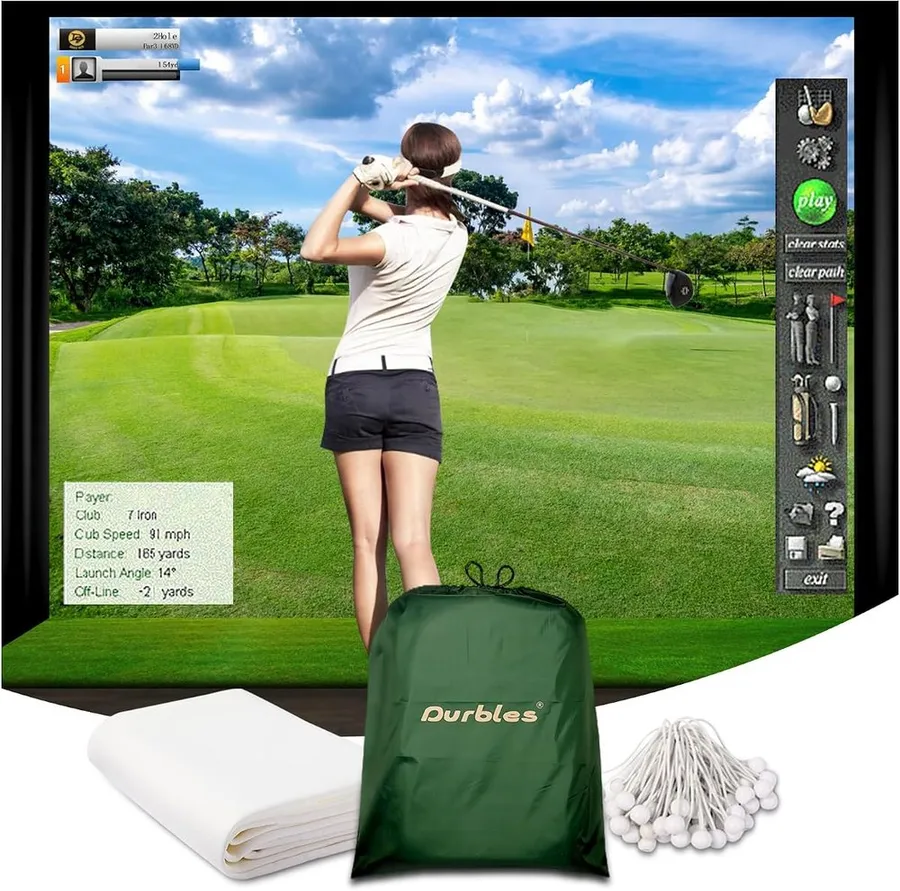
The cheapest simulator is often one you assemble yourself, and this triple-layer impact screen is the low-cost surface that lets you project a course onto a frame you already have.
What we like
- Triple-layer construction absorbs driver impacts and keeps a sharp image
- Grommets and bungee cords let you tension it flat on any frame
- Far cheaper than buying a full enclosure package
- Strong owner ratings for image quality and durability
What we don't
- It is only the screen, so you supply the frame, projector and launch monitor yourself
| Type | Impact screen |
|---|---|
| What you get | Triple-layer HD screen, grommets, bungees |
| Best for | DIY simulator builds |
| Price | $160 |
| Warranty | 1 year |
| Install difficulty | Moderate |
| Price bracket | $ |
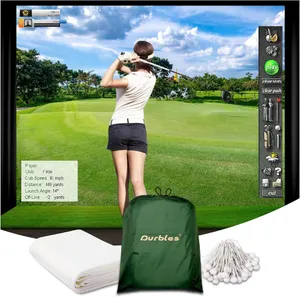
If you already have a spare wall, some conduit or a net frame, the cheapest route to a simulator is to hang a good screen and project onto it, and this triple-layer model is built for exactly that. It takes the full force of a driver, deadens the sound and still shows a bright, clean picture, which is the whole job of an impact screen.
Setting it up is a bit more hands-on than a packaged kit. The grommets and included bungee cords let you tension the screen flat across your own frame so it does not ripple, but you do have to supply that frame, a projector and a launch monitor to complete the simulator. That is the trade for the low price.
Its one real limitation is right there in the box: this is a screen and nothing else. If you do not already own or plan to build a frame, the total cost of adding one can close the gap to a complete enclosure package, so add everything up first.
Choose it when you enjoy a build and want to spend your budget on the parts that matter rather than a branded shell. If you would rather one box arrive with the frame and cage ready to assemble, step up to the complete enclosure package instead.
Research-based pick: this recommendation is based on product data, owner feedback and comparison with products we have tested, not on direct hands-on testing.
Buy it if: DIY builders framing their own bay who just need a quality screen
Skip it if: You want a ready-to-hang kit with the frame and cage included
Best for Small Spaces
10x8 Golf Simulator Enclosure
by Golf Sim
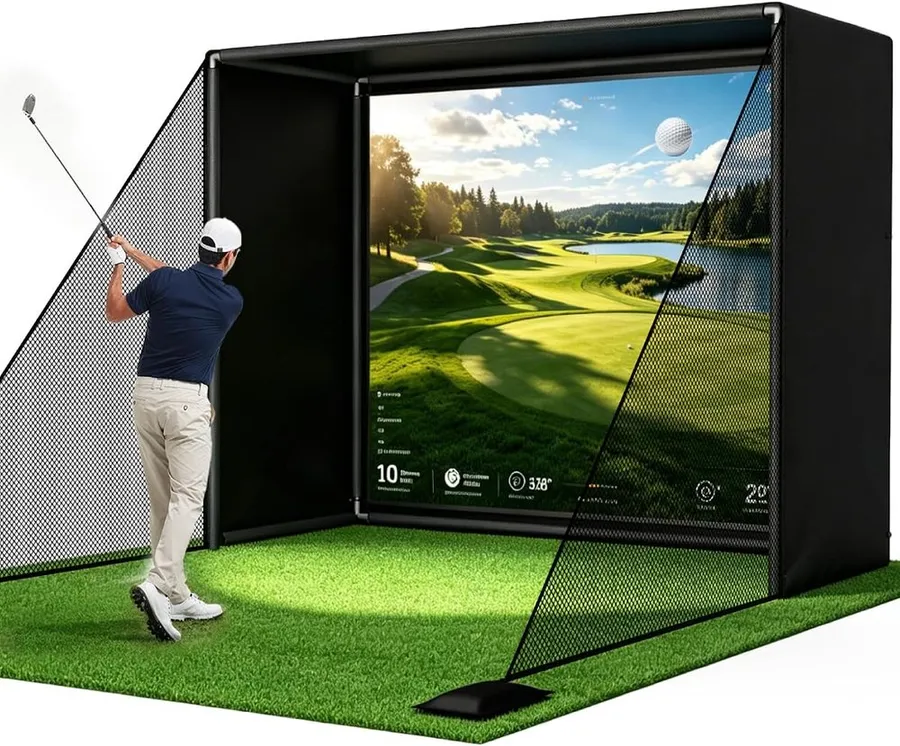
At 10 by 8 feet with a screen and side nets already included, this budget enclosure is the cheapest ready-made shell that fits a single-car garage or spare room.
What we like
- Compact 10x8 ft footprint fits a single-car garage or tight room
- Includes the impact screen and dual side nets, not just a frame
- Steel frame with corner foam padding for safety
- One of the lowest-priced complete enclosures available
What we don't
- A lighter build than premium enclosures, so it wears faster under daily driver sessions
| Type | Enclosure + screen |
|---|---|
| What you get | 10x8 ft steel frame, impact screen, side nets |
| Best for | Small rooms and garages |
| Price | $400 |
| Warranty | 1 year |
| Install difficulty | Moderate |
| Price bracket | $ |
Space is what stops most indoor simulator projects, and this enclosure answers it by keeping things compact and cheap. At 10 by 8 feet it slots into a single-car garage or a spare room, and unlike a bare frame it arrives with the impact screen and dual side nets already included, so you are catching balls the day it is built.
In use it does the core job well for the money. The steel frame holds the triple-layer screen taut, the side barriers stop shanks from finding a wall, and corner foam padding takes the edge off the frame in a tight room. Add a projector and a launch monitor and you have a working simulator in a small footprint.
The limitation is build weight. This is a lighter enclosure than the premium options, which is exactly why it is affordable, but that means relentless daily driver sessions will wear it faster than a heavier branded cage. For regular practice it is fine; for a punishing everyday workload, plan to spend more.
Pick it if your room is small and your budget is tight and you want a shell that is ready to hang a projector onto. If you have a wider bay or you swing hard every day, the sturdier GoSports enclosure is the safer long-term buy.
Research-based pick: this recommendation is based on product data, owner feedback and comparison with products we have tested, not on direct hands-on testing.
Buy it if: Golfers with a small garage or room who want a cheap ready-made shell
Skip it if: You have a large bay and hit hard enough to need a heavier frame
Best Value Kit
Complete Golf Simulator Enclosure Package
by Complete Golf Simulator
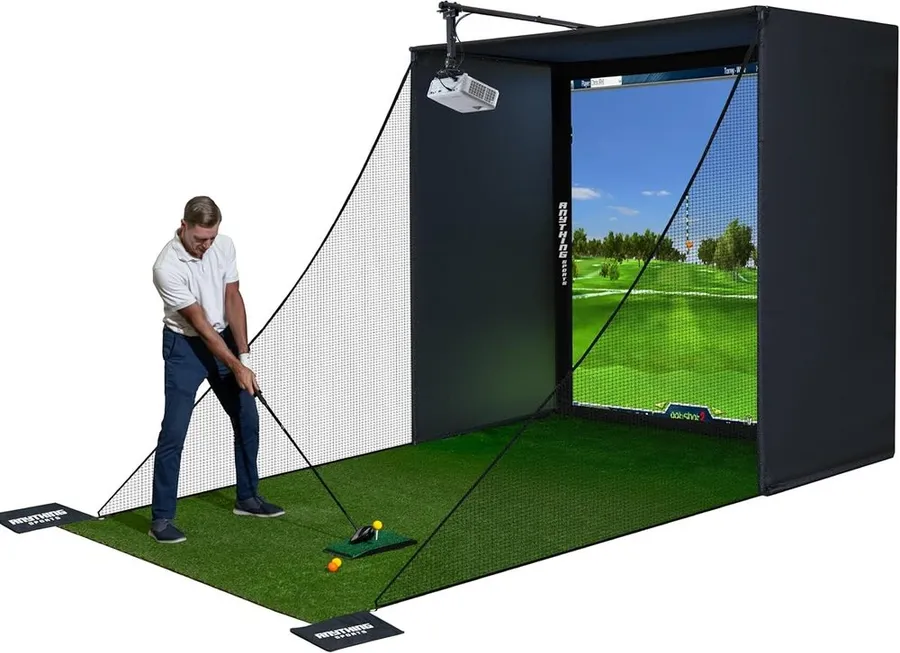
This package bundles a 4K-ready screen, a blackout cage and a projector mount into one box, doing most of the physical build for you at a price that still leaves room in the budget for a launch monitor.
What we like
- 4K-ready impact screen with a blackout cage for a bright, clean image
- Includes a projector mount and frame poles, so little is left to source
- Sets up quickly compared with framing a bay yourself
- Backed by a 12-month warranty and strong owner ratings
What we don't
- You still add a launch monitor, projector and mat before it plays a course
| Type | Enclosure + screen |
|---|---|
| What you get | 4K-ready screen, blackout cage, projector mount |
| Best for | A near-complete room setup |
| Price | $700 |
| Warranty | 1 year |
| Install difficulty | Moderate |
| Price bracket | $$ |
The sweet spot between a bare screen and a five-figure studio is a complete enclosure package, and this one earns Best Value Kit by handing you almost the whole physical build in a single box. You get the 4K-ready impact screen, a blackout cage that darkens the picture for a sharper image, frame poles and even a projector mount, so the parts that are fiddly to source separately are already matched.
Living with it is straightforward. The blackout cage genuinely helps contrast in a bright garage, the screen handles driver impacts, and the included mount means you are not improvising a projector rig from timber. Owners consistently praise how much of the job it does for the price, and it carries a 12-month warranty.
The honest limitation is that it is still an enclosure, not a simulator. It has no launch monitor, projector or mat inside, so you must add those before it plays a round. Once you tally the tech, factor the full total rather than the shell price alone.
Buy it if you want the enclosure and screen decision settled in one order and you are happy to add a monitor like the MLM2PRO and a projector. If you would rather everything arrive together and just switch on, look at the SkyTrak all-in-one studio.
Research-based pick: this recommendation is based on product data, owner feedback and comparison with products we have tested, not on direct hands-on testing.
Buy it if: Buyers who want the enclosure decision made in one purchase
Skip it if: You want a full turnkey studio that arrives with the tech included
Best Premium Enclosure
GoSports Golf Simulator Enclosure
by GoSports
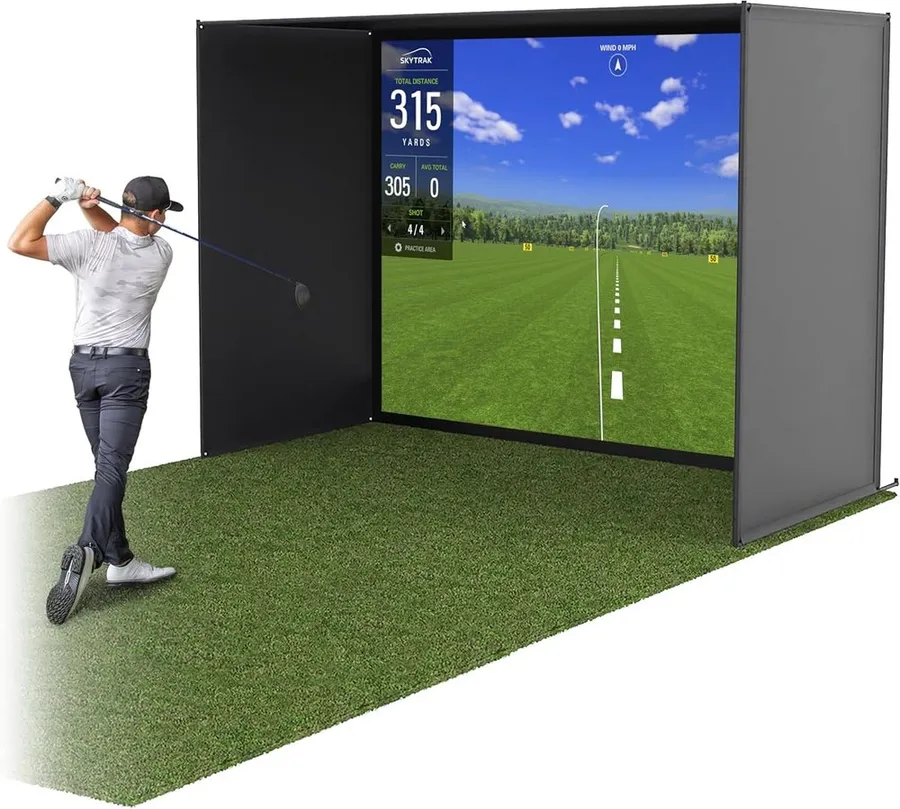
GoSports builds the sturdiest shell in this budget-minded lineup, a heavier steel frame with an HD impact screen that stands up to hard, frequent driver sessions and comes in three sizes.
What we like
- Heavier steel frame built to survive frequent hard driver use
- HD impact screen produces a bright, sharp projected image
- Choice of 10x8, 12x9 or 14x8 ft to match your room
- Trusted brand with a large base of positive owner reviews
What we don't
- Costs around a thousand dollars for the shell before you add any tech
| Type | Enclosure + screen |
|---|---|
| What you get | Steel frame, HD impact screen, net kit |
| Best for | A durable premium enclosure |
| Price | $1,000 |
| Warranty | 1 year |
| Install difficulty | Moderate |
| Price bracket | $$ |
When your build is going to take a beating, the frame matters, and the GoSports enclosure is the toughest shell in this lineup. Its heavier steel frame and HD impact screen are made to absorb daily driver sessions without sagging or fraying, which is where cheaper cages eventually give way. It also comes in three sizes, so you can match it to a small garage or a wider dedicated bay.
Day to day it feels reassuringly solid. The screen throws a bright, sharp image, the frame stays square under repeated impacts, and the brand backing means replacement parts and support are easier to find than with unbranded kits. For a player who practices often, that durability is the whole point.
The catch is simply cost. At around a thousand dollars this is the most expensive enclosure here before you have added a launch monitor, projector or mat, so it only makes sense if you value longevity over the lowest possible entry price.
Choose it if you play regularly and want an enclosure you will not have to replace, and you have the budget for the tech on top. If money is tight or you only hit a few balls a week, the lighter 10x8 enclosure saves several hundred dollars.
Research-based pick: this recommendation is based on product data, owner feedback and comparison with products we have tested, not on direct hands-on testing.
Buy it if: Regular players who want a durable enclosure that lasts for years
Skip it if: You are on the tightest budget or only practice occasionally
Best All-in-One
SkyTrak ST MAX Ultimate Studio Package
by SkyTrak
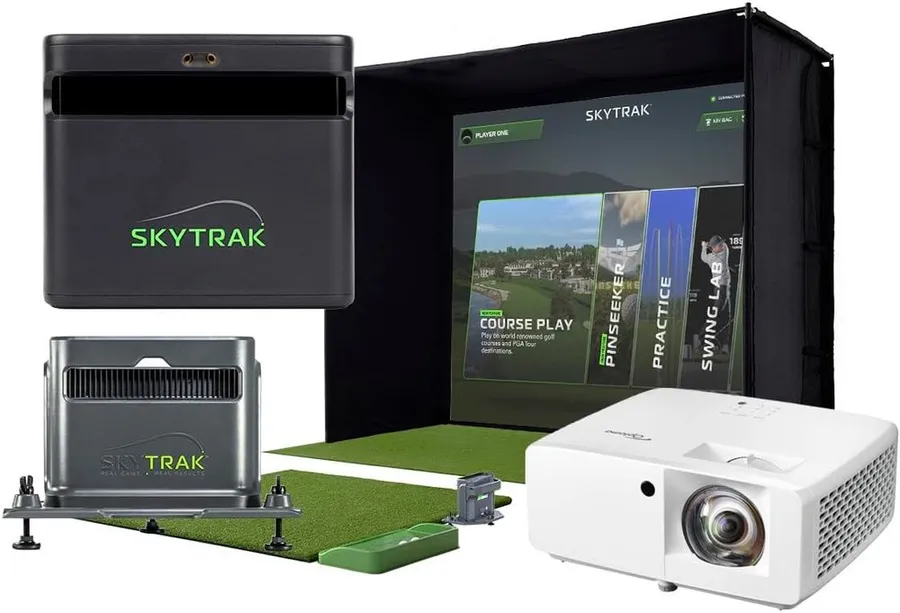
If your idea of cheap is the lowest total cost with zero sourcing headaches, the SkyTrak ST MAX studio arrives as one box with the monitor, screen, projector, mat and enclosure already matched.
What we like
- Everything included: launch monitor, screen, projector, mat and enclosure
- Dual radar and photometric monitor gives accurate, reliable data
- No parts to source or match, so nothing is missing on setup day
- Built-in speed training tools alongside course and range play
What we don't
- By far the most expensive option, and the software has its own subscription tiers
| Type | All-in-one studio |
|---|---|
| What you get | Launch monitor, screen, projector, mat, enclosure |
| Best for | A one-box premium studio |
| Price | $4,995 |
| Warranty | 1 year |
| Install difficulty | Moderate |
| Price bracket | $$$ |
Cheap can mean lowest sticker or lowest hassle, and the SkyTrak ST MAX Ultimate Studio owns the second definition. Rather than sourcing a monitor, screen, projector, mat and enclosure separately and hoping they fit together, you get one package with every piece already matched, including a dual radar and photometric launch monitor that delivers genuinely accurate data.
In use it is the closest thing here to a commercial bay at home. The monitor reads full ball and club numbers, the bundled projector and screen are sized to the enclosure, and there are speed training tools built in alongside course and range play. Nothing is missing on setup day, which is a real advantage over piecing a build together.
The limitation is plain: price. At just under five thousand dollars it costs many times more than any other pick, and the software carries its own subscription tiers, so it only belongs in this guide as the premium endpoint for buyers who want it all in one delivery.
Buy it if you want a finished studio with no guesswork and the budget to match. If you are trying to spend as little as possible, a launch monitor like the MLM2PRO paired with a budget enclosure gets you playing courses for a small fraction of the cost.
Research-based pick: this recommendation is based on product data, owner feedback and comparison with products we have tested, not on direct hands-on testing.
Buy it if: Buyers who want a complete studio in one box with no assembly guesswork
Skip it if: You are trying to spend as little as possible up front
How we researched these picks#
We built this list by starting from the ways people actually get golf simulation into a home for the least money, then filtering hard on evidence and relevance. Every product here is real and currently sold, and we prioritized items with a meaningful base of verified owner reviews so the guide reflects gear you can order and trust today rather than untested listings.
Because the cheapest indoor golf simulator is really a spectrum, we deliberately spread the seven picks across every budget route. There is a launch monitor that plays courses on its own, a swing-stick sensor for the tightest budget, a standalone impact screen for DIY builds, three enclosures at rising prices and sizes, and a complete one-box studio at the premium end. For each one we read the manufacturer listing, compared aggregated owner feedback and judged it head to head on total cost to play, space needed, data accuracy, build effort and value.
These recommendations are research-based, not hands-on tested. We have not set up each system in our own garage, so we lean on published specifications and the consistent themes in owner reviews rather than personal range data. Where a pick has a real weakness, such as approximate sensor data, a subscription or the fact that it is only a shell, we say so plainly so you can budget for the rest.
How to choose a cheap indoor golf simulator (buying guide)#
Decide what cheap means to you. The lowest sticker is a swing-stick sim under $300, but it only estimates your shots. The lowest total cost with real data is a budget launch monitor paired with a net or screen. The lowest hassle is a complete package or a one-box studio that costs more but arrives matched. Pick the definition that fits you before you compare prices.
Measure your space, especially ceiling height. A simulator lives or dies on room dimensions. Aim for roughly 10 feet wide and 10 feet deep, and confirm you have at least 9 feet of height to swing a driver, more if you are tall. A swing-stick sim needs almost nothing, a 10x8 enclosure fits a single-car garage, and the wider cages need a dedicated bay, so measure before choosing among golf simulators for home use. Ceiling height ends most builds, so check it first.
Weigh accuracy against price. A motion sensor that clips to your club infers ball flight and is fine for casual rounds but not for fixing a swing. A camera-and-radar launch monitor measures the ball and gives data you can actually train on. If you only want to play, save your money; if you want to improve, spend up to a real monitor.
Add up the whole build, not just one part. An enclosure or a bare screen is not a simulator on its own. You still need a launch monitor, a projector and a mat, and none of those come inside a shell. Before you compare a cheap enclosure with a launch monitor, total everything each route requires so you are comparing complete setups.
Match the screen and frame to how hard you hit. The impact screen takes the full force of every shot, so a multi-layer screen absorbs driver strikes and stays quiet. A light 10x8 cage is fine for regular practice, but relentless daily driver sessions call for a heavier branded enclosure. Pay for the durability your usage actually demands rather than the cheapest frame that technically fits.
Check for subscriptions before you buy. Several budget simulators lean on software, and the richest features or course libraries can sit behind a paid membership. Confirm what the sticker includes and what recurring fee unlocks the rest, then fold that cost into your comparison so the cheapest option up front is still the cheapest to own.
Frequently asked questions
What is the cheapest way to get an indoor golf simulator?
The cheapest genuine simulator is a swing-stick sensor like PHIGOLF at under $300, which plays virtual courses without any enclosure. The cheapest setup that measures your actual ball, rather than estimating it, is a launch monitor like the Rapsodo MLM2PRO paired with any net or screen. A DIY build using a standalone impact screen on a frame you already own can also come in cheaply, but you supply the projector and monitor yourself.
How much space do I need for an indoor golf simulator?
Plan for a room roughly 10 feet wide, 10 feet deep and at least 9 feet tall so you can swing a driver without catching the ceiling, and closer to 10 feet of height if you are tall. A swing-stick sim like PHIGOLF needs almost no space, while the 10x8 enclosures here fit a single-car garage. Ceiling height is the constraint that ends most builds, so measure it before you buy anything.
Do cheap golf simulators give accurate data?
It depends on the technology. A motion sensor that clips to your club estimates ball flight from your swing, so the numbers are approximate and fine for fun rounds but not for serious practice. A camera-and-radar launch monitor actually measures the ball and gives far more reliable data. If accuracy matters to you, spend up to a real launch monitor rather than a swing-stick sensor.
Can I build a cheap simulator from separate parts?
Yes, and it is often the best value. A standalone impact screen on a frame, a budget projector, a launch monitor and a mat can undercut a packaged studio, though it takes assembly and some trial and error. If you would rather not source and match parts, a complete enclosure package settles the shell in one order and a one-box studio like SkyTrak arrives fully matched for the highest price.
About the author

Jim Bennett Founder & lead reviewer
Jim is the guy behind Golf Sim Jim. He builds home golf simulators and compares launch monitors by the numbers that actually decide a setup, room fit, accuracy and software.
Home setup: Garage bay: SkyTrak+, 10 ft ceiling, BenQ LK936ST short-throw
- Launch monitor accuracy
- Home simulator builds
- Impact screens & enclosures
- Sim software (GSPro, E6, TGC)