
7 Golf Simulator Setups by Price for 2026, $59 to $1,000
We compared golf simulator price across 7 real setups, from a $59 net to a $1,000 enclosure, on data, space and value to find your best pick.

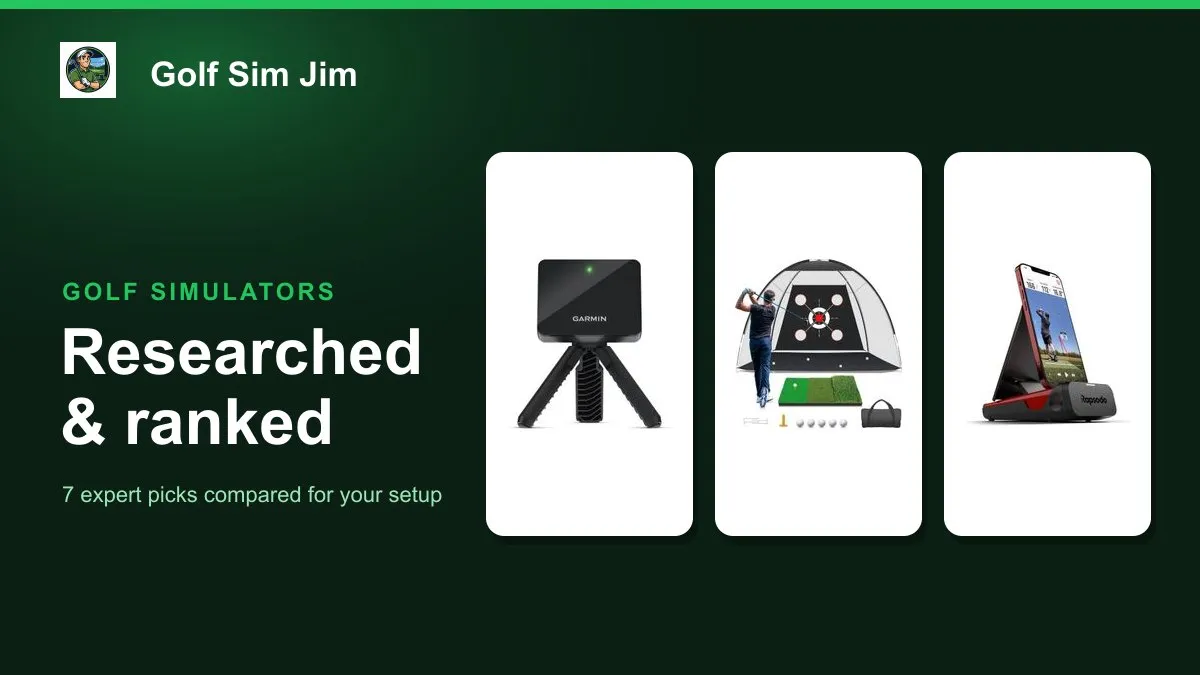
Golf simulator price is confusing because the same phrase covers a $59 net and a $1,000 enclosure, and the sticker rarely tells you what you actually get. This guide clears it up by comparing seven real, currently sold setups arranged as a price ladder from about $59 to $1,000, spanning a bare hitting net, entry and mid-range launch monitors, a swing-sensor stick and screen enclosures. For each rung we weighed the things that decide whether the money is well spent: how accurate the data is and the technology behind it, how much room the setup needs, what software or subscriptions it carries, what is included in the box, and overall value at the price. The aim is to show you where the sensible spending tiers sit so you can match a setup to your budget and your space, instead of overpaying for capability you will not use or underspending on data you cannot trust. Below you will find the best overall value pick plus category winners for budget, beginners, casual play, accuracy, simulator use and premium builds, followed by a plain buying guide.
Table of contents
- Quick picks
- Price compared
- Comparison table
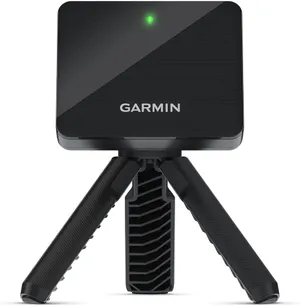
- Best Overall: Garmin Approach R10
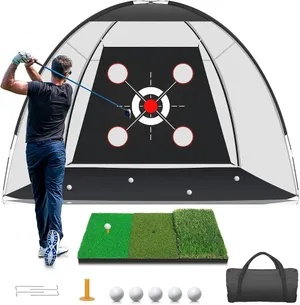
- Best Budget: 10x7 Golf Practice Net with Mat
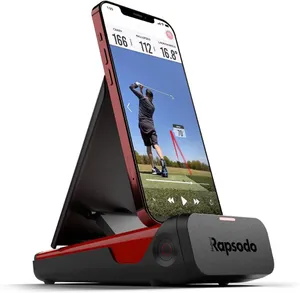
- Best for Beginners: Rapsodo Mobile Launch Monitor
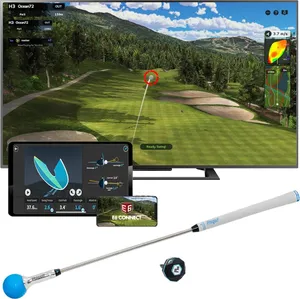
- Best for Casual Play: PHIGOLF Home Golf Simulator
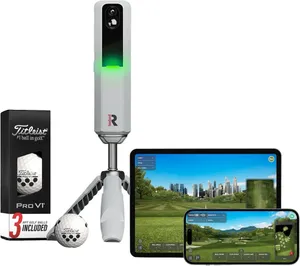
- Best for Accuracy: Rapsodo MLM2PRO
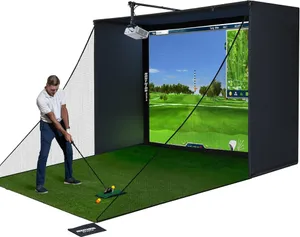
- Best for Simulator Use: Complete Golf Simulator Enclosure Package
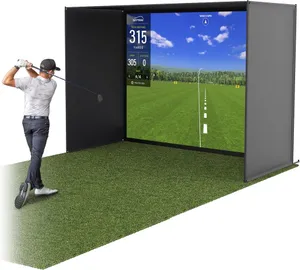
- Best Premium: GoSports Golf Simulator Enclosure
- How we researched these picks
- How to choose a golf simulator by price (buying guide)
- FAQ
Quick picks
Every pick wins a specific use case. Jump to the full review before you buy.
-
Best Overall
Garmin Approach R10
At around $500 the Garmin Approach R10 sits at the sweet spot of the price ladder, giving you real launch data indoors or at the range without the cost of a camera unit or a full enclosure build.
-
Best Budget
10x7 Golf Practice Net with Mat
At around $59 this net and mat kit is the cheapest way to swing real clubs at home, and it proves you do not need four figures to start practicing indoors or in the yard.
-
Best for Beginners
Rapsodo Mobile Launch Monitor
At about $200 the original Rapsodo Mobile Launch Monitor is the cheapest way to get real ball and club speed numbers, making it the friendliest first step from a bare net into data-driven practice.
-
Best for Casual Play
PHIGOLF Home Golf Simulator
At around $280 PHIGOLF swaps launch data for on-screen courses, giving families the cheapest way to actually play virtual golf in a small room.
-
Best for Accuracy
Rapsodo MLM2PRO
At around $600 the dual-camera MLM2PRO reads shots more precisely and in tighter spaces than the radar units, and it bundles three Pro V1 balls to prove the point.
-
Best for Simulator Use
Complete Golf Simulator Enclosure Package
At around $800 this enclosure package supplies the screen, cage and mounts a projector-based sim needs, turning a launch monitor into a true hit-into-the-screen setup.
-
Best Premium
GoSports Golf Simulator Enclosure
At around $1,000 the GoSports enclosure is the priciest setup here, buying a sturdier frame, a larger HD screen and the polish of a known brand for a permanent room.
Compare every pick
| Product | Award | Type | What's included | Space needed | Price | Warranty | Best for | Where to buy |
|---|---|---|---|---|---|---|---|---|
| Garmin Approach R10 | Best Overall | Radar launch monitor | Monitor, tripod, phone mount, case, app | Range or roughly 10 ft indoor room | $500 | 1 year | Golfers who want the best all-round data per dollar | Check price on Amazon for Garmin Approach R10 at Amazon (affiliate link) |
| 10x7 Golf Practice Net with Mat | Best Budget | Hitting net + mat | Net, frame, hitting mat, target | Backyard or garage, 10 x 7 ft | $59 | 30-day returns | Beginners on a tight budget who just want to hit balls at home | Check price on Amazon for 10x7 Golf Practice Net with Mat at Amazon (affiliate link) |
| Rapsodo Mobile Launch Monitor | Best for Beginners | Radar launch monitor | Monitor, iOS app, GPS range view | Driving range or large room | $200 | 1 year | First-time buyers who want data without a big spend | Check price on Amazon for Rapsodo Mobile Launch Monitor at Amazon (affiliate link) |
| PHIGOLF Home Golf Simulator | Best for Casual Play | Swing-stick sensor sim | Motion sensor, swing stick, app, 38,000 courses | Small room, roughly 8 ft swing space | $280 | 1 year | Families and casual players who want to play courses, not measure swings | Check price on Amazon for PHIGOLF Home Golf Simulator at Amazon (affiliate link) |
| Rapsodo MLM2PRO | Best for Accuracy | Dual-camera launch monitor | Monitor, 3 Pro V1 balls, app, 15 metrics | Range or roughly 10 ft indoor room | $600 | 1 year | Improvers who want the most accurate data in this price range | Check price on Amazon for Rapsodo MLM2PRO at Amazon (affiliate link) |
| Complete Golf Simulator Enclosure Package | Best for Simulator Use | Enclosure + impact screen | 4K screen, blackout cage, frame poles, projector mount | Garage or room, roughly 10 x 8 ft | $800 | 1 year | Buyers building a dedicated projector-based simulator room | Check price on Amazon for Complete Golf Simulator Enclosure Package at Amazon (affiliate link) |
| GoSports Golf Simulator Enclosure | Best Premium | Enclosure + impact screen | Frame, HD impact screen, enclosure net | Garage or room, up to 14 x 8 ft | $1000 | 1 year | Buyers building a permanent, full-size simulator bay | Check price on Amazon for GoSports Golf Simulator Enclosure at Amazon (affiliate link) |
Swipe sideways to compare every column.
Best Overall
Garmin Approach R10
by Garmin
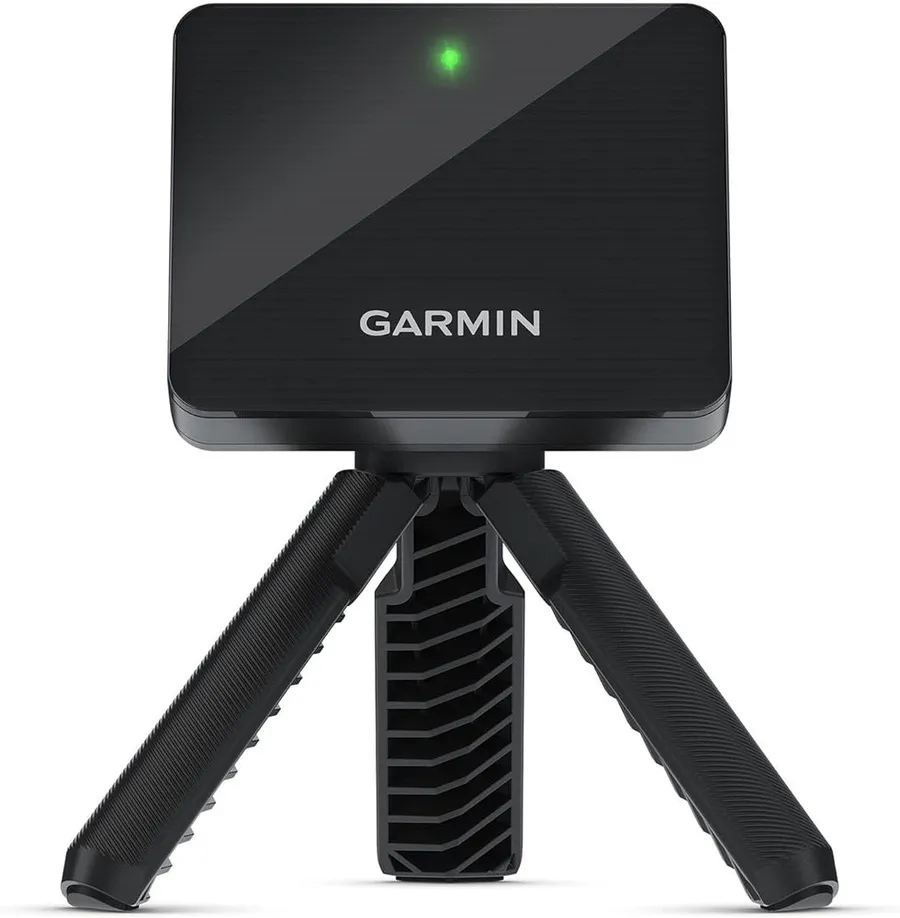
At around $500 the Garmin Approach R10 sits at the sweet spot of the price ladder, giving you real launch data indoors or at the range without the cost of a camera unit or a full enclosure build.
What we like
- Reads 14 shot metrics with a radar unit that works both indoors and at the range
- Ships with tripod, phone mount and case, so nothing extra is needed to start
- Up to 10 hours of battery and a free app with virtual courses built in
What we don't
- Radar needs roughly 8 to 10 feet of ball flight, so very short rooms will struggle
| Type | Radar launch monitor |
|---|---|
| What's included | Monitor, tripod, phone mount, case, app |
| Space needed | Range or roughly 10 ft indoor room |
| Price | $500 |
| Warranty | 1 year |
| Install difficulty | Easy |
| Price bracket | $$ |
The Garmin Approach R10 is the pick most home golfers should start with because it answers the real question behind “how much does a golf simulator cost?” You do not need a five-figure bay to get trustworthy numbers. For about $500 the R10 tracks ball speed, club speed, spin, launch angle and 14 metrics in total, and it does so both in the garage and out on the range.
It wins best overall on value. Cheaper options on this list either give you no data at all, like a bare net, or lean on a phone-only workflow, like the original Rapsodo MLM. The R10 hits the balance point: it costs a fraction of a camera-based or premium enclosure setup, yet it pairs with sim software and its own app of virtual courses. That is why it anchors most affordable home builds.
Day to day it is genuinely grab and go. The included tripod, phone mount and case mean setup takes a minute, the battery lasts a full session, and you can move it between the backyard and an indoor screen. Its one real limitation is space: as a radar unit it wants several feet of ball flight to read a shot cleanly, so a tight room can hurt accuracy.
Buy the R10 if you want the most capable all-rounder for the money. If your room is very short, a camera-based monitor like the MLM2PRO reads better up close, and if you only want to groove a swing without data, a net setup will save you hundreds.
Research-based pick: this recommendation is based on product data, owner feedback and comparison with products we have tested, not on direct hands-on testing.
Buy it if: Golfers who want the best all-round data per dollar
Skip it if: Your room is too short for the ball to fly a few feet
Best Budget
10x7 Golf Practice Net with Mat
by Home Golf Practice
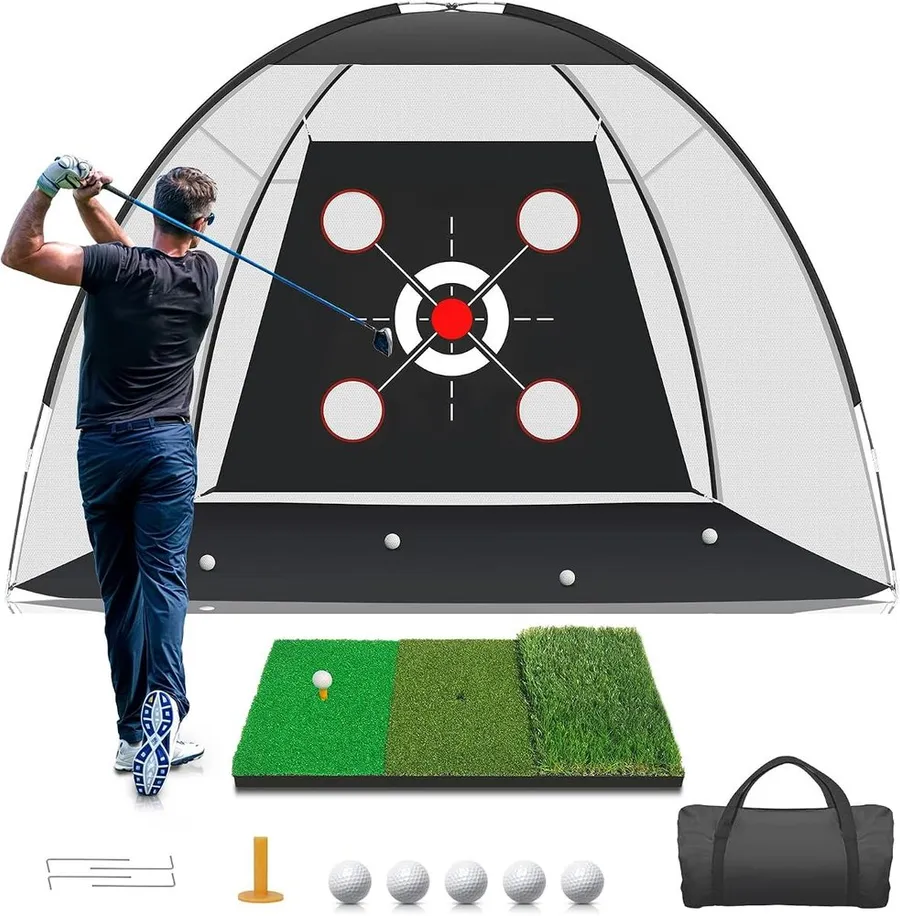
At around $59 this net and mat kit is the cheapest way to swing real clubs at home, and it proves you do not need four figures to start practicing indoors or in the yard.
What we like
- Costs a fraction of any launch monitor while letting you hit full shots
- Includes the net, frame, mat and a target, so it is ready out of the box
- Folds down and moves between the garage and the backyard easily
What we don't
- Gives you zero shot data, so it builds feel but not measured improvement
| Type | Hitting net + mat |
|---|---|
| What's included | Net, frame, hitting mat, target |
| Space needed | Backyard or garage, 10 x 7 ft |
| Price | $59 |
| Warranty | 30-day returns |
| Install difficulty | Easy |
| Price bracket | $ |
This net and mat kit is the honest floor of the golf simulator price question. For about $59 you get a 10 by 7 foot net, a frame, a hitting mat and a target: enough to swing a real driver in the garage or backyard without breaking anything or spending real money.
It wins best budget because nothing else here comes close on price, and it removes the single biggest barrier to practicing at home, which is having somewhere safe to hit into. Owners use it to warm up before a round, groove tempo in the evening, or keep swinging through the off-season without a range trip.
What it will not do is give you a single number. There is no radar, no camera and no app, so it builds feel rather than measured data. If you later add a launch monitor like the R10 or MLM2PRO, this net still earns its keep as the thing you hit into.
Buy this if the goal is simply to swing at home cheaply and you are not chasing metrics yet. If you want carry distances and spin, step up to a radar unit, and if you want on-screen virtual courses, a sensor sim or full enclosure is the next rung.
Research-based pick: this recommendation is based on product data, owner feedback and comparison with products we have tested, not on direct hands-on testing.
Buy it if: Beginners on a tight budget who just want to hit balls at home
Skip it if: You want any numbers on ball speed, spin or carry
Best for Beginners
Rapsodo Mobile Launch Monitor
by Rapsodo
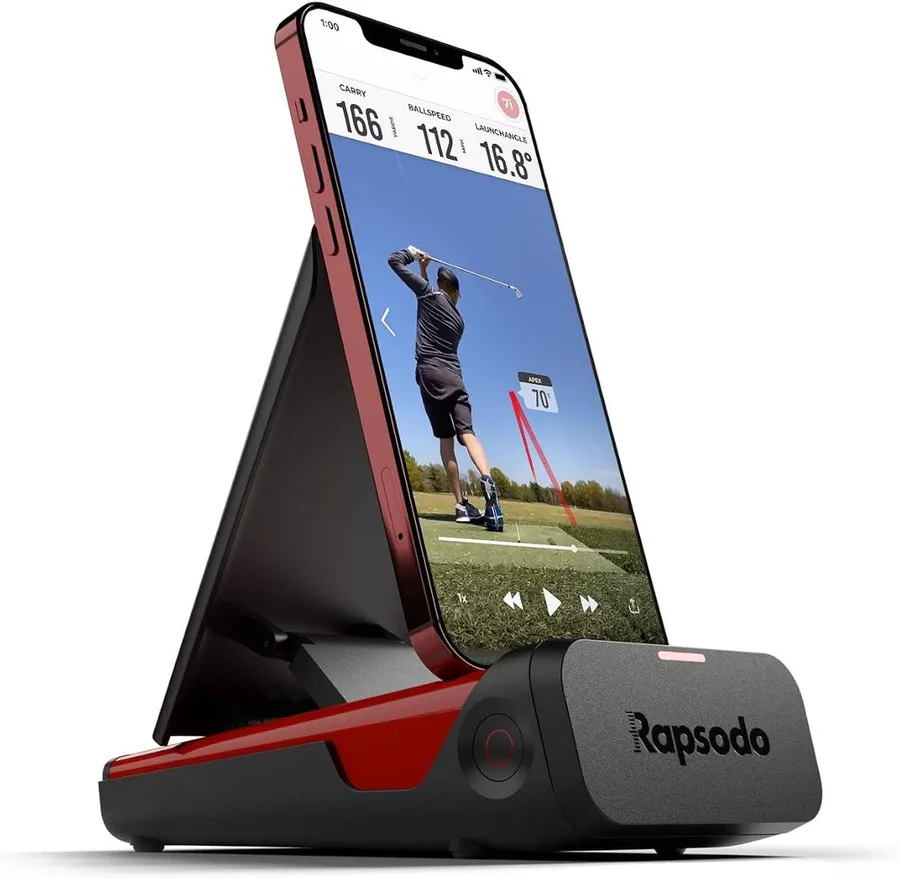
At about $200 the original Rapsodo Mobile Launch Monitor is the cheapest way to get real ball and club speed numbers, making it the friendliest first step from a bare net into data-driven practice.
What we like
- Lowest price of any launch monitor here, so the entry cost is small
- Delivers ball speed, club speed and launch angle with GPS range view
- Very simple iPhone-based setup that is easy for a first-timer
What we don't
- iOS only and best outdoors, so it is less flexible than the R10
| Type | Radar launch monitor |
|---|---|
| What's included | Monitor, iOS app, GPS range view |
| Space needed | Driving range or large room |
| Price | $200 |
| Warranty | 1 year |
| Install difficulty | Easy |
| Price bracket | $ |
The original Rapsodo Mobile Launch Monitor is the gentlest on-ramp to measured practice. For around $200 it is the least expensive way on this list to see actual numbers, and with several thousand owner reviews it is a proven, well-understood first monitor.
It wins best for beginners because the jump from a $59 net to real data usually costs far more. The MLM keeps that jump small: pair it with an iPhone, set it behind the ball, and you get ball speed, club speed, launch angle and a GPS satellite view of your shots at the range. For someone testing whether they even want data, that low commitment is the point.
The trade-offs explain the price. It is iPhone and iPad only, it leans on outdoor range use rather than tight indoor rooms, and it reports fewer metrics than the pricier Garmin and camera units. Those are fair limits for the money, not dealbreakers for a starter.
Buy the MLM if you want the cheapest genuine launch data and you own an iPhone. If you are on Android, want to play indoors, or want a fuller metric set, spend up to the Garmin R10 or the MLM2PRO instead.
Research-based pick: this recommendation is based on product data, owner feedback and comparison with products we have tested, not on direct hands-on testing.
Buy it if: First-time buyers who want data without a big spend
Skip it if: You use Android or want to play mostly indoors
Best for Casual Play
PHIGOLF Home Golf Simulator
by PHIGOLF
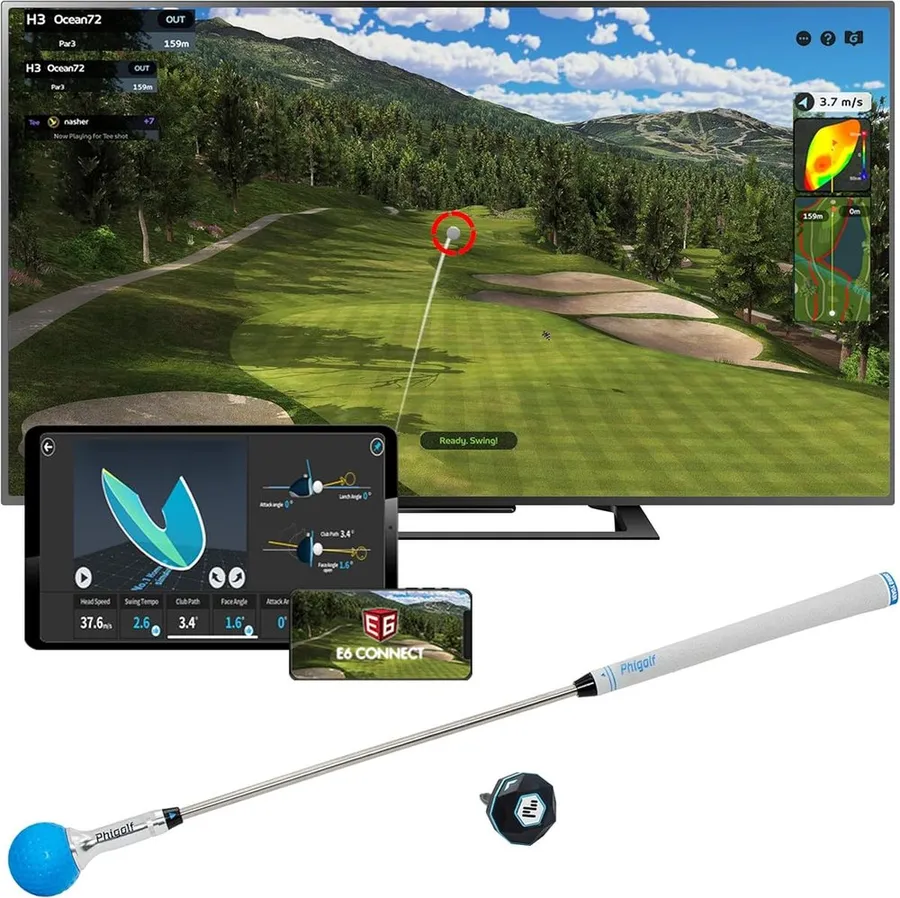
At around $280 PHIGOLF swaps launch data for on-screen courses, giving families the cheapest way to actually play virtual golf in a small room.
What we like
- Opens 38,000-plus virtual courses for well under the cost of a launch monitor
- Motion sensor and swing stick need only a small amount of swing space
- Works with Android and iOS plus E6 Connect for a real sim feel
What we don't
- Sensor-based motion tracking is far less accurate than radar or camera data
| Type | Swing-stick sensor sim |
|---|---|
| What's included | Motion sensor, swing stick, app, 38,000 courses |
| Space needed | Small room, roughly 8 ft swing space |
| Price | $280 |
| Warranty | 1 year |
| Install difficulty | Easy |
| Price bracket | $ |
PHIGOLF answers a different question than the launch monitors here. Instead of asking how accurately you can measure a swing, it asks how cheaply you can play a round of virtual golf in the living room. For about $280 you get a motion sensor, a swing stick and access to more than 38,000 courses.
It wins best for casual play because that combination is genuinely fun for the money. The swing stick means you do not need a full net or much room, the app runs on Android and iOS, and it even connects to E6 Connect for a more simulator-like experience. For families, kids or anyone who wants to hit shots on famous holes rather than study spin rates, it delivers.
The honest limit is accuracy. It reads the motion of a sensor, not the ball, so the data is nowhere near what a radar or camera unit produces. Treat it as a game and a swing-tempo toy rather than an improvement tool and it makes sense.
Buy PHIGOLF if the goal is affordable on-screen play in a small space. If you actually want to lower your handicap with trustworthy numbers, put the money toward the Rapsodo MLM, the Garmin R10 or the camera-based MLM2PRO.
Research-based pick: this recommendation is based on product data, owner feedback and comparison with products we have tested, not on direct hands-on testing.
Buy it if: Families and casual players who want to play courses, not measure swings
Skip it if: You want accurate ball and club numbers to improve
Best for Accuracy
Rapsodo MLM2PRO
by Rapsodo
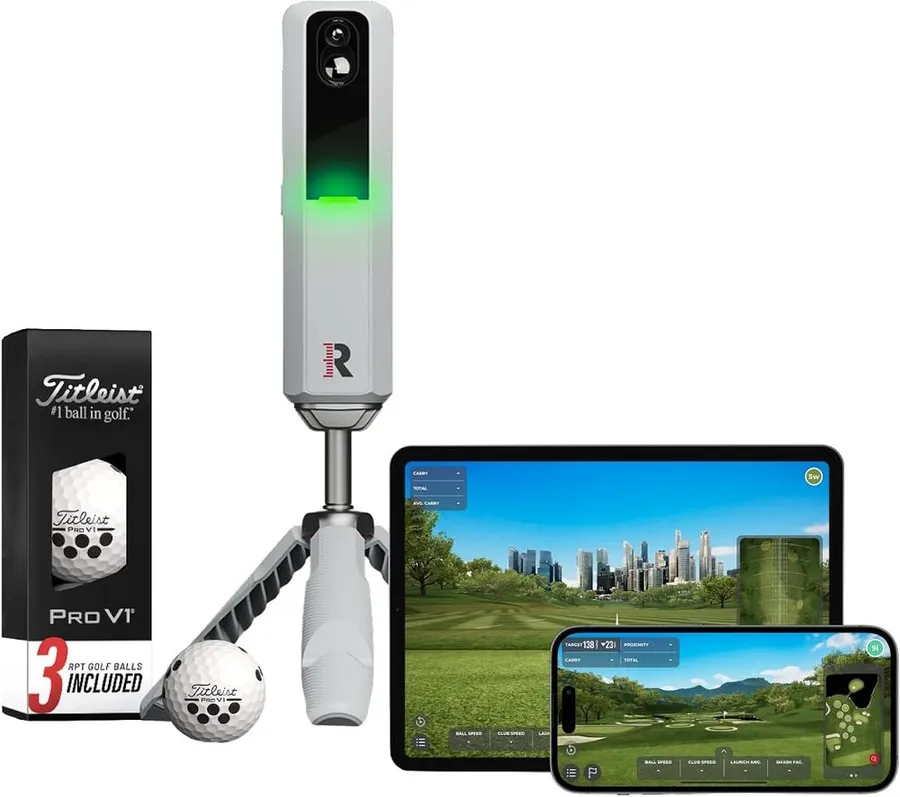
At around $600 the dual-camera MLM2PRO reads shots more precisely and in tighter spaces than the radar units, and it bundles three Pro V1 balls to prove the point.
What we like
- Dual-camera plus radar system captures 15 metrics with strong accuracy
- Reads shots in shorter indoor rooms than a radar-only unit
- Includes three Pro V1 balls and a polished app with course play
What we don't
- Costs more than the R10 and some premium features sit behind a subscription
| Type | Dual-camera launch monitor |
|---|---|
| What's included | Monitor, 3 Pro V1 balls, app, 15 metrics |
| Space needed | Range or roughly 10 ft indoor room |
| Price | $600 |
| Warranty | 1 year |
| Install difficulty | Easy |
| Price bracket | $$ |
The Rapsodo MLM2PRO is where this list starts paying for precision rather than just access. For about $600 it pairs dual high-speed cameras with radar, which lets it capture 15 metrics and read impact more directly than a radar-only device. It even ships with three Pro V1 balls so you can use its optically marked ball tracking right away.
It wins best for accuracy because the camera element is the key. Radar units like the R10 and MLM infer numbers from ball flight and want several feet of room. The MLM2PRO reads more of the shot up close, so it holds up better in shorter indoor spaces and gives improvers spin and launch figures they can trust more.
Living with it is easy: it is portable, the app is well built, and it works indoors or at the range. The catch is money and model. It costs noticeably more than the Garmin R10, and some of the nicer features, like unlimited shot storage and certain course play, sit behind a subscription.
Buy the MLM2PRO if accuracy in a normal-sized room is your priority and the extra cost is fine. If you want the best value all-rounder, the R10 is the smarter buy, and if you just want to hit into a screen, an enclosure paired with a cheaper monitor stretches further.
Research-based pick: this recommendation is based on product data, owner feedback and comparison with products we have tested, not on direct hands-on testing.
Buy it if: Improvers who want the most accurate data in this price range
Skip it if: You want the lowest price or a simple no-subscription setup
Best for Simulator Use
Complete Golf Simulator Enclosure Package
by Complete Sim
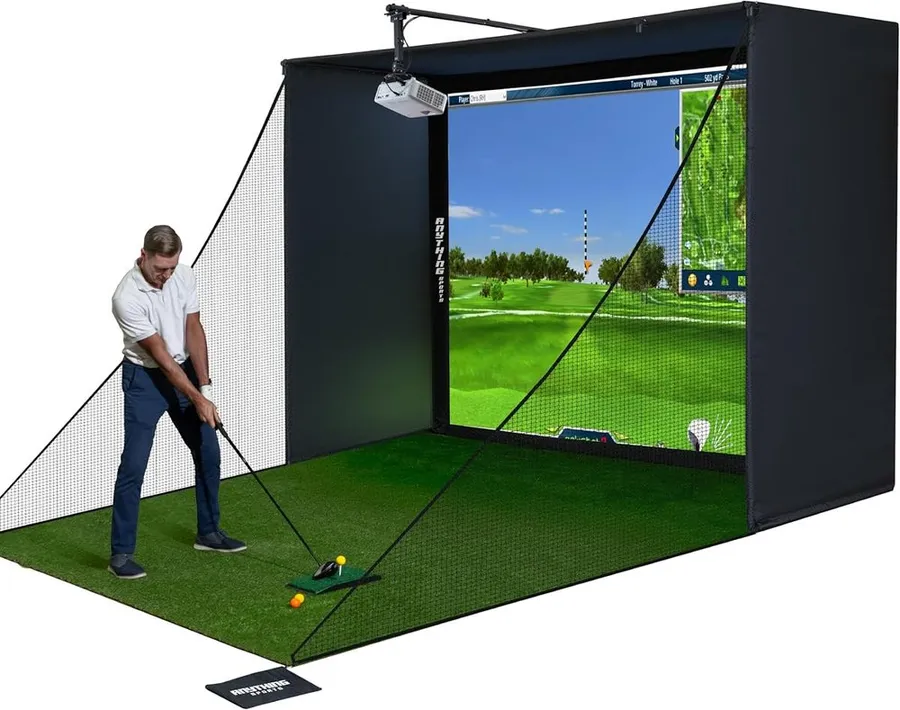
At around $800 this enclosure package supplies the screen, cage and mounts a projector-based sim needs, turning a launch monitor into a true hit-into-the-screen setup.
What we like
- 4K-ready impact screen and blackout cage give a real simulator picture
- Includes frame poles, projector mount and side nets, so it is a full kit
- Much cheaper than a commercial bay while covering the whole build-out
What we don't
- It is only the enclosure, so you still budget for a launch monitor and projector
| Type | Enclosure + impact screen |
|---|---|
| What's included | 4K screen, blackout cage, frame poles, projector mount |
| Space needed | Garage or room, roughly 10 x 8 ft |
| Price | $800 |
| Warranty | 1 year |
| Install difficulty | Moderate |
| Price bracket | $$ |
This enclosure package is the piece that turns a launch monitor into an actual simulator. For about $800 it provides a 4K-ready impact screen, a blackout cage, frame poles, a projector mount and side shank nets: everything you build around a monitor and projector to hit into a full-screen course.
It wins best for simulator use because it is the missing middle of most home builds. A monitor gives you data and a net gives you a target, but neither projects a course onto a screen in front of you. This kit does, and the blackout cage keeps the projected image bright, which is what makes the experience feel like a real bay.
Setup is more involved than the plug-and-play monitors here, so budget an afternoon for the frame and screen tensioning. And remember what it is not: the price does not include the launch monitor or projector, so it is one line item in a larger simulator budget rather than a complete solution on its own.
Buy this if you already own or plan to buy a monitor and projector and want the enclosure to tie it together at a fair price. If you just want to hit balls, a plain net saves hundreds, and if you want a bigger, tougher cage, the GoSports enclosure steps up.
Research-based pick: this recommendation is based on product data, owner feedback and comparison with products we have tested, not on direct hands-on testing.
Buy it if: Buyers building a dedicated projector-based simulator room
Skip it if: You have not yet bought a launch monitor or projector
Best Premium
GoSports Golf Simulator Enclosure
by GoSports
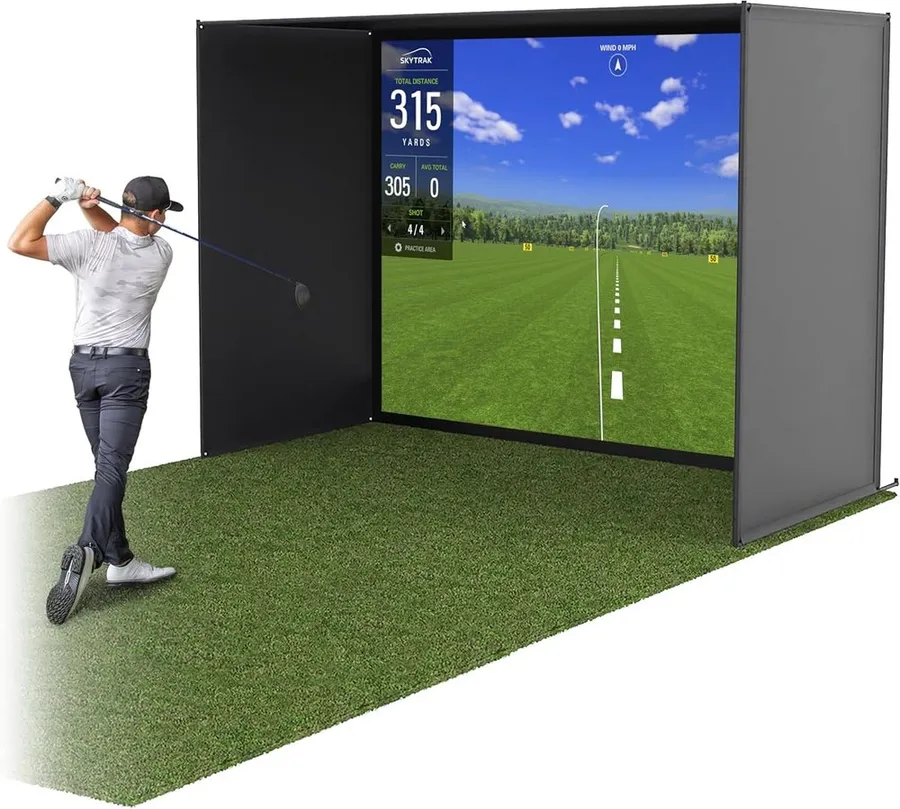
At around $1,000 the GoSports enclosure is the priciest setup here, buying a sturdier frame, a larger HD screen and the polish of a known brand for a permanent room.
What we like
- Larger enclosure options up to 14 x 8 ft for a full-size hitting bay
- HD impact screen and complete frame from a well-reviewed brand
- Strongest owner rating in this roundup for build quality and fit
What we don't
- Top price on this list and still needs a monitor and projector added
| Type | Enclosure + impact screen |
|---|---|
| What's included | Frame, HD impact screen, enclosure net |
| Space needed | Garage or room, up to 14 x 8 ft |
| Price | $1000 |
| Warranty | 1 year |
| Install difficulty | Moderate |
| Price bracket | $$$ |
The GoSports enclosure is the premium end of the golf simulator price ladder. At about $1,000 it is the most expensive pick here, and what you pay for is a bigger, sturdier bay: a complete frame with an HD impact screen in sizes up to 14 by 8 feet, from a brand with a strong track record in home golf gear.
It wins best premium because it is built for a room you intend to keep. The larger footprint suits a full driver swing, the screen quality holds up for projected courses, and it carries the highest owner rating in this roundup, which matters when you are committing to a fixed installation. This is the enclosure you buy when the sim is a permanent fixture, not an experiment.
The obvious caveats are cost and scope. It sits at the top of the price range, and like any enclosure it still needs a launch monitor and projector to become a working simulator. Setup is a proper project rather than a five-minute unbox.
Buy the GoSports enclosure if you want the most durable, full-size bay and the budget supports a complete build. If you want the same idea for less, the $800 enclosure package covers the essentials, and if you only need a target, a simple net does the job for under $100.
Research-based pick: this recommendation is based on product data, owner feedback and comparison with products we have tested, not on direct hands-on testing.
Buy it if: Buyers building a permanent, full-size simulator bay
Skip it if: You want the cheapest way into a screen setup
How we researched these picks#
We built this list by starting from the setups people actually buy at each price point, then filtering hard on evidence and relevance. Every product here is a real, currently sold unit or kit, and we favored those with a meaningful base of verified owner reviews so the ladder reflects gear you can order today rather than spec-sheet promises.
For each candidate we pulled the manufacturer or listing specifications, read across aggregated verified owner feedback and compared setups head to head on the factors that decide value: measurement accuracy and the technology behind it, how much space the setup needs, what software and subscriptions it carries, what is actually included in the box, and value at the price. Because this is a price guide, we deliberately spread the seven picks across brackets, from a $59 net to a $1,000 enclosure, so you can see exactly where each spending tier lands and what the extra money buys.
These recommendations are research-based, not hands-on tested. We have not built each setup ourselves, so we lean on published specs and the consistent themes in owner feedback rather than our own range data. Where a product carries a hidden cost, such as a subscription, a required projector or approximate data, we call it out plainly so the price you compare is the price you pay.
How to choose a golf simulator by price (buying guide)#
Decide whether you are buying data or a game. The single biggest price driver is whether the setup measures your real ball. A bare net at $59 only gives you somewhere safe to swing. A launch monitor from $200 measures actual ball and club numbers. A swing-sensor stick like PHIGOLF costs less than most monitors but estimates the shot rather than reading it, which is fine for fun and poor for improvement.
Match the technology to your space. Radar monitors like the Garmin R10 want roughly 8 to 10 feet of ball flight, so they suit a garage, a tall room or the range. A dual-camera unit like the Rapsodo MLM2PRO reads closer to impact and fits shorter rooms. A swing stick or a net needs the least room of all. Measure your ceiling and swing space before you shop, because the wrong technology in a small room wastes money.
Separate the monitor from the screen. The most common price mistake is assuming a launch monitor projects a course onto a screen. It does not. A standalone monitor plays through your phone or tablet. Adding a full-size projected image means buying an enclosure, a projector and a computer on top, which is why the $800 and $1,000 enclosures here are only one part of a larger bill.
Add up subscriptions and required extras. Sticker price is rarely the whole story. The Rapsodo MLM2PRO gates its best metrics and course play behind a paid annual plan after year one, and every enclosure still needs a monitor and projector. Total the full stack, including any recurring membership, so two setups at the same headline price are compared fairly.
Check platform and software compatibility. The original Rapsodo MLM runs on iPhone and iPad only, so Android owners should look at the Garmin R10, the MLM2PRO or PHIGOLF instead. Confirm the companion app supports your device and offers the courses or metrics you care about, because software often decides how much you enjoy a setup more than a small hardware spec.
Buy the rung that fits, not the top of the ladder. Spend the least that still covers the accuracy and space you have. The net gets you swinging for under $100, the Rapsodo MLM adds real data cheaply, the Garmin R10 is the best all-round value, the MLM2PRO buys accuracy in a normal room, and the enclosures only make sense once you have a monitor and projector to fill them. Most warranties here run one year, so let capability and total cost, not the warranty, make the call.
Frequently asked questions
How much does a golf simulator cost?
It depends entirely on what you count as a simulator. In this guide the setups run from about $59 for a hitting net with a mat to $1,000 for a full enclosure with an impact screen. The most useful middle ground is a launch monitor that measures real shots and plays courses through an app, and those sit between roughly $200 and $600. Screen enclosures add $800 or more on top, and still need a monitor and projector to work.
What is the cheapest golf simulator that gives real data?
The original Rapsodo Mobile Launch Monitor at around $200 is the lowest-cost credible unit that measures actual ball and club numbers, though it is iPhone and iPad only. A $59 net lets you swing at home for less but records nothing, and a PHIGOLF swing stick near $280 plays virtual courses but senses your motion rather than measuring the ball.
Does the price include a screen and projector?
Almost never. A launch monitor like the Garmin R10 or Rapsodo MLM2PRO plays through your phone or tablet on its own. An enclosure package supplies the screen and cage but not the monitor or projector. To get a projected, full-size image you budget for the monitor, the enclosure, a projector and a computer together, so total the whole stack before comparing prices.
Do subscriptions change the real price?
They can. The original Rapsodo MLM, the PHIGOLF stick and the net-and-mat kits carry no mandatory fees, but the Rapsodo MLM2PRO puts its full metric set and course play behind a paid annual plan after the first year. Add any recurring membership to the sticker price so two setups at the same cost are judged on equal terms.
About the author

Jim Bennett Founder & lead reviewer
Jim is the guy behind Golf Sim Jim. He builds home golf simulators and compares launch monitors by the numbers that actually decide a setup, room fit, accuracy and software.
Home setup: Garage bay: SkyTrak+, 10 ft ceiling, BenQ LK936ST short-throw
- Launch monitor accuracy
- Home simulator builds
- Impact screens & enclosures
- Sim software (GSPro, E6, TGC)